Most Vi players who ask me for help are not losing because their combo is too short. They are losing because they have one approach, one way out of the corner, and a tag button they press with their eyes closed. Then they spend a week in training mode learning a route that adds sixty damage and drops half the time online.
So this is the opposite of that. Three mechanics, all of them low effort, all of them things I actually use every single set at Grandmaster. One gives you a movement option nobody blocks correctly. One makes your tag safe when it is usually the most punishable thing you do. And one is me proving with real damage numbers that the flashy combo you are grinding is not worth it.
Here is the full breakdown on video if you want to watch the inputs happen in real time. The written version below goes deeper on the why, which is the part that actually transfers to your matches.
Why these three and not a forty-hit combo
2XKO is a two-touch game. If you open somebody up twice, the round is usually over. That single fact should change what you practice. When two touches end it, the thing that decides matches is how often you get the touch and how often you avoid giving one away — not whether your touch does 339 or 400.
Every mechanic below targets one of those two things. Better approach, safer tag, and a combo you will not drop under lag. None of them take more than a session to get comfortable with.
1. Vi’s air electric foot (her secret air dash)
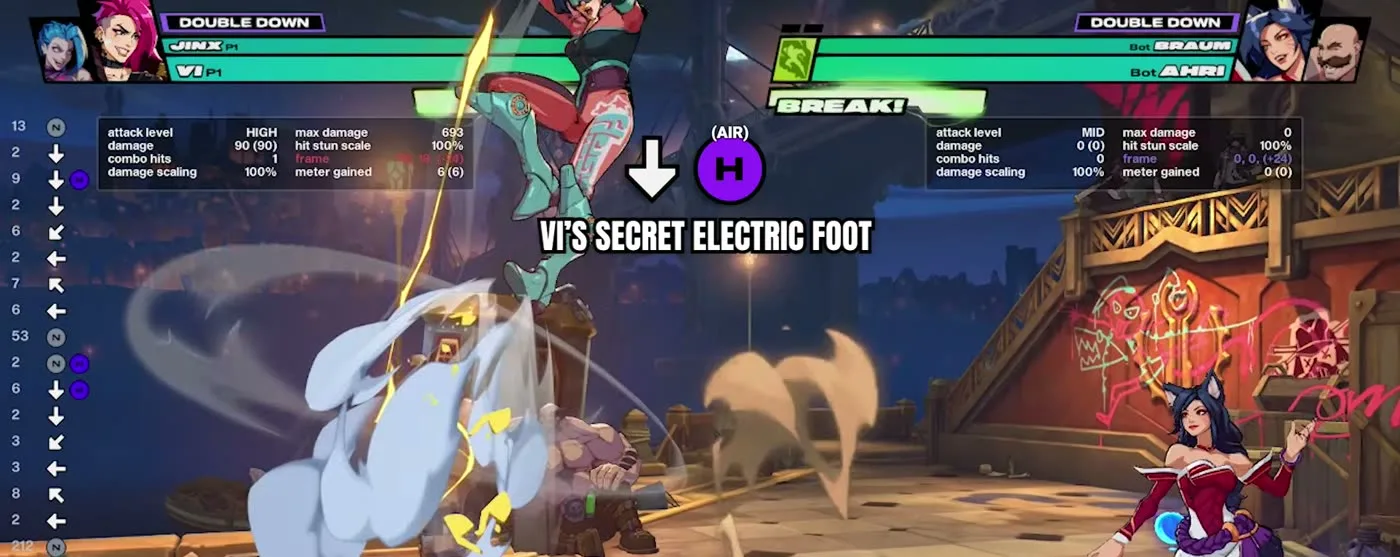
Vi does not have a real air dash. What she has is an air heavy that travels, and once you understand how far it goes and where it puts you, it fills the same role. I call it the electric foot because it electrifies the opponent on contact, which matters for what comes after.
The input is stranger than it looks
Jump, then press down and heavy. That is it. The part that surprises people is what the horizontal direction does:
- Hold back — you still travel forward. It does not reverse.
- Neutral — you travel forward.
- Hold forward — you travel forward, but noticeably further.
So there is no version of this move that retreats. Once you accept that, you stop panicking with it and start using it as a committed approach, which is what it is. Go into training mode and do all three versions back to back so you can feel the distance difference. It is bigger than you would guess.
What it actually does on hit
Two things, and both of them are good for you.
First, it crosses up. You end up on the other side of them. That alone wins games at every rank below Master because the block direction flips mid-air and most people do not adjust in time.
Second, it leaves them electrified, which is Vi’s whole gimmick. That state is what makes her follow-ups work, so a move that applies it while also repositioning you is doing two jobs at once.
The two situations I use it in
Getting out of the corner. You are pinned, they are pressuring, you block one thing and jump. Electric foot sends you over them and now they are the ones with a wall behind them. This is the single most valuable use of it and it is the one people never think of, because the move feels like offense.
Full-screen approach behind an assist. Call your partner, let the assist occupy their block, and electric foot in behind it. From full screen this closes an absurd amount of distance and they have to deal with two things arriving at once. If you main Vi and Jinx like I do, the missile is a perfect cover for this — see the Jinx guide for which assist calls actually give you time.
What it does not do — read this part
It is still a jump-in. That means it can be anti-aired like any other jump-in. If you throw it at a player who knows their anti-air button, you will get clipped out of the air over and over, and because you committed to a forward-moving heavy there is no bailing out halfway.
Treat it as a strong option, not a free one. If they anti-air it twice, stop doing it for a while and make them respect the ground.
For follow-ups after the electric foot connects, air medium gives you the better distance and air heavy gives you the cross-up. Pick based on which side you want to land on, not on which one does more.
2. Charge S1 to cover your tag
Tagging is the most dangerous thing you do in this game. There is a window where your incoming character is just arriving and cannot defend, and good players sit on that window and blow you up for free. It is especially rough right after a Break, when everyone knows a tag is coming.
Why a raw charge S1 is normally bad
On its own, a charged S1 is a bad button in neutral. It is slow, it is telegraphed, and anyone paying attention will just parry it. If you throw it out raw against a decent player you are going to eat a punish. That is why most people write it off entirely.
Why it is great specifically as tag cover
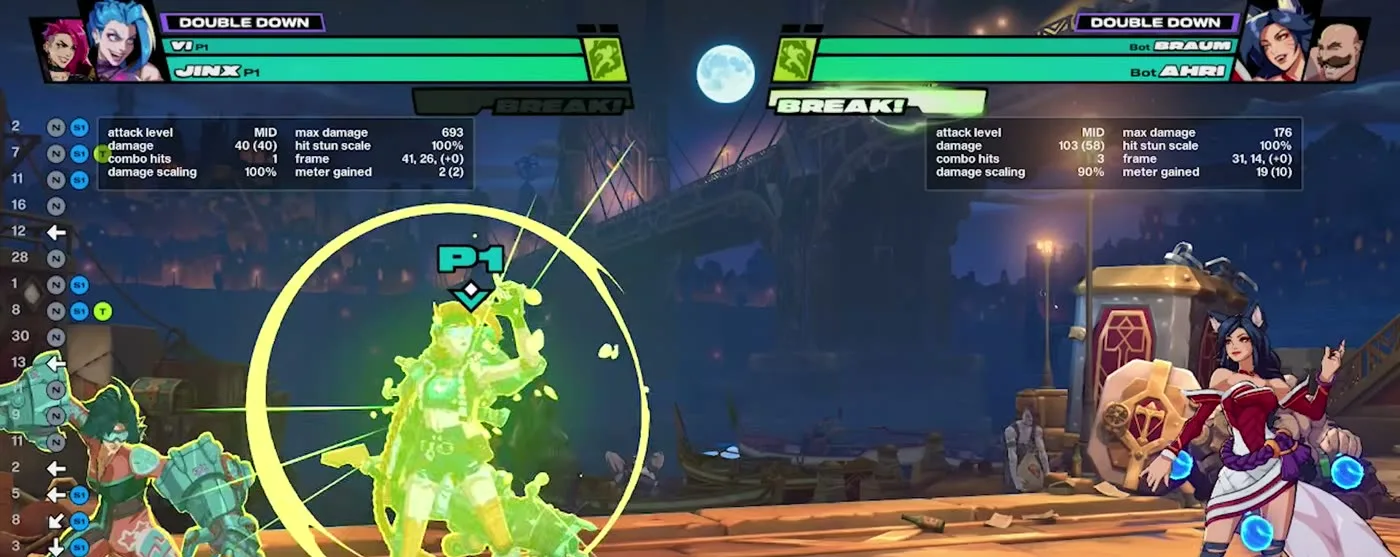
Because the weakness stops mattering. You were not trying to hit them with it — you were trying to make them deal with something during the exact frames your tag is exposed. If they parry the S1, fine, they burned their parry on a move you were never counting on, and your tag came out behind it. If they do not parry it, they are blocking or getting hit, and either way they are not punishing the tag.
You have converted a move with one obvious answer into a move where the answer costs them something.
The sequence I actually run
- Call the Jinx missile assist.
- Start charging S1 behind it.
- Tag out.
Now there are two things in front of the tag window, and the opponent has to parry both of them correctly to get anywhere near you. That is a much harder ask than parrying one telegraphed button. Against most players it simply does not happen, and you get a completely free character swap in a spot where you would normally be gambling.
This is the highest-value habit on this list, because tag punishes are the kind of damage that ends rounds you were winning. If you want the fundamentals behind why the assist timing works, the Fuses explained guide covers what each fuse changes about your assist and tag options.
3. Do the simpler combo — I measured it
This is the one people argue with me about, so I went into training mode and got the actual numbers instead of arguing from feel.
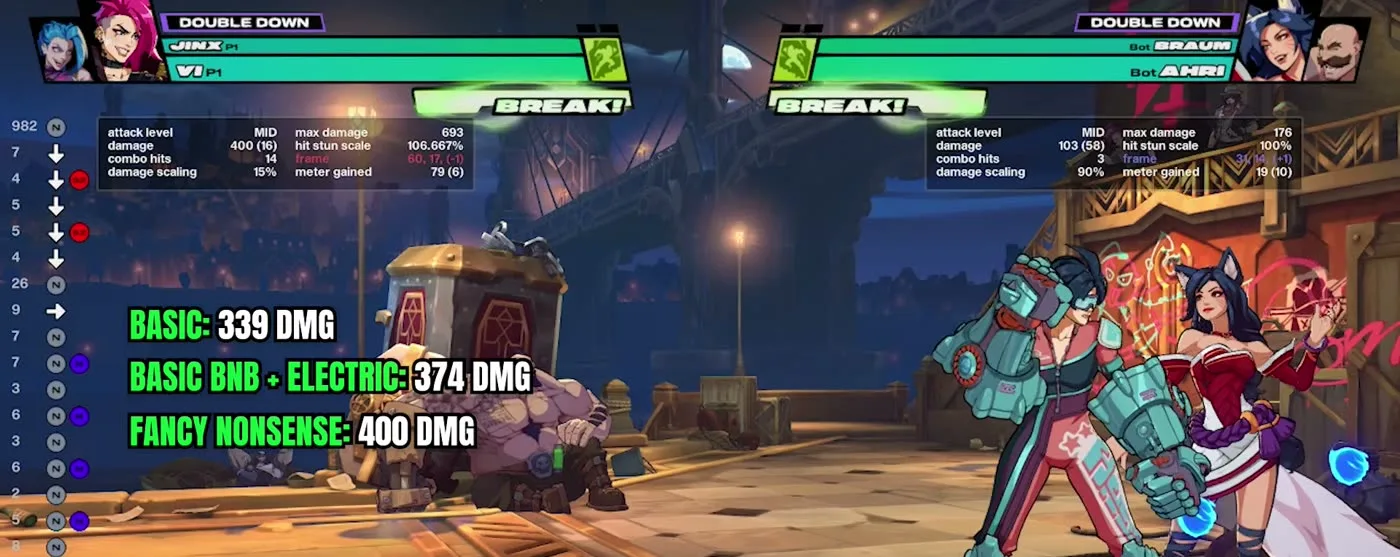
- Basic BnB — 339 damage. The one you already know.
- Basic BnB plus electric — 374 damage. One extra piece, still easy.
- The fancy electric route — 400 damage. Tight timing, real execution.
61 damage is not worth a drop
Sixty-one damage. That is the entire gap between the combo a brand new player can do and the combo you would spend a week in the lab on.
Now add online. Rollback is good in this game but it is not magic, and one frame of misread input turns your 400 route into a dropped combo, a reset to neutral, and their turn. You did not lose 61 damage — you lost the whole 400 and gave up the offensive position. Do that once per game and the hard combo is now costing you damage, not earning it.
The middle option is the honest answer for almost everyone. Basic BnB plus the electric piece gets you 374 — that is 92 percent of the maximum for a fraction of the difficulty. Take the free 35 damage, skip the risky 26.
End in Limit Strike, not super
Related habit, same logic. Most players end every combo in super because it is the biggest number on screen. But if you end in Limit Strike instead, you come out of the combo with roughly 20 percent meter gained, a setup on the way out, and you are left plus.
Compare that honestly. Super spends your resource for a chunk of damage that, in a two-touch game, often was not the difference. Limit Strike builds resource, keeps you on offense, and hands you the next mixup. Save the super for when it actually closes the round.
The one thing that matters most here
If you only take one idea from this: your execution ceiling is not your problem. Your problem is that you have one approach and an unsafe tag.
Every rank I have coached through — Aspirant, Gold, Platinum, Diamond — the players stuck there are stuck for options, not for damage. They can do a combo. They cannot get in a second way, and they cannot switch characters without getting punished. Fix those two and your win rate moves before your combo does.
Honest caveats
- The damage numbers are from one starter. Different starters scale differently, so treat 339 / 374 / 400 as the shape of the gap, not a universal constant. The shape is what matters: the gap is small.
- Electric foot loses to a prepared anti-air. At high level you cannot lead with it. It is a mixup within a gameplan, not a gameplan.
- Charge S1 tag cover is not unbeatable. Someone who knows the setup can parry the assist and the S1. It is a strong default, not a lock.
- Patches move things. Frame data and damage change. The reasoning survives patches; the exact numbers do not.
What to practice this week
- Ten minutes of electric foot distances. Back, neutral, forward. Learn the three ranges by feel so you stop guessing whether you will reach.
- Corner escape reps. Set the dummy to pressure you in the corner, block, jump, electric foot out. Do it until it is reflex rather than a decision.
- Assist plus charge S1 plus tag, twenty times. Just the sequence. Get the rhythm into your hands so it is available under pressure.
- Drop the hard combo for a week. Run the 374 route exclusively in ranked and see whether your damage per game actually goes down. I do not think it will.
- End three combos in Limit Strike per set. Notice the meter you finish the round with.
If you want more structure than that, the 5 daily drills guide is the warm-up routine I actually run, and the Vi guide has her full button breakdown. New to reading inputs like S1 and 2H? Start with numpad notation, then combo system basics.
The short version
- Air electric foot is down plus heavy in the air. It always goes forward, it crosses up, and it electrifies. Use it to escape the corner and to approach behind an assist.
- It is still a jump-in, so it can be anti-aired. Do not lead with it every round.
- Charge S1 during your tag — especially after a Break. Bad move in neutral, great move as cover, because it forces a parry during the frames you are exposed.
- Assist, then charge S1, then tag makes them solve two problems instead of one.
- Basic BnB is 339, plus electric is 374, fancy is 400. Sixty-one damage separates easiest from hardest — take the middle one.
- End in Limit Strike for about 20 percent meter, a setup, and plus frames instead of spending your super for damage you did not need.
- It is a two-touch game. Getting the touch beats maximizing the touch.
Want me to look at your Vi?
I run one-on-one coaching where we go through your actual replays and find the specific habit that is costing you rounds — usually it is one of the two things above. You can book a session here, or come hang out in the Discord and post a clip.
And if you want to see where Vi sits against the rest of the roster right now, the current tier list is up and you can build your own version of it too.