Most Vi players can do a combo. Far fewer can actually get the combo. That gap is what keeps people stuck — you know the punish, you just never get the opening, so you spend the whole round throwing the same block string into a wall and hoping.
Vi’s pressure is filthy once you know what she has. These are the seven tools I actually used to climb to high Grandmaster, in the order I’d learn them. Some are bread-and-butter you should have on day one. One of them is honestly a bit of a trap that I’m including anyway because it teaches you something. And the last one is the single most important pressure concept in the game right now, for every character, not just Vi.
Here’s the video if you want to see every string executed in real time. The written version below adds the frame context, when each one fails, and what to drill first.
Set your lab up first — this takes ten seconds
Before any of this, go make the dummy block. Otherwise you’re practicing combos, not pressure, and those are completely different skills.
- Press Start in the training room.
- Go to Bots.
- Set Block Settings to Always.
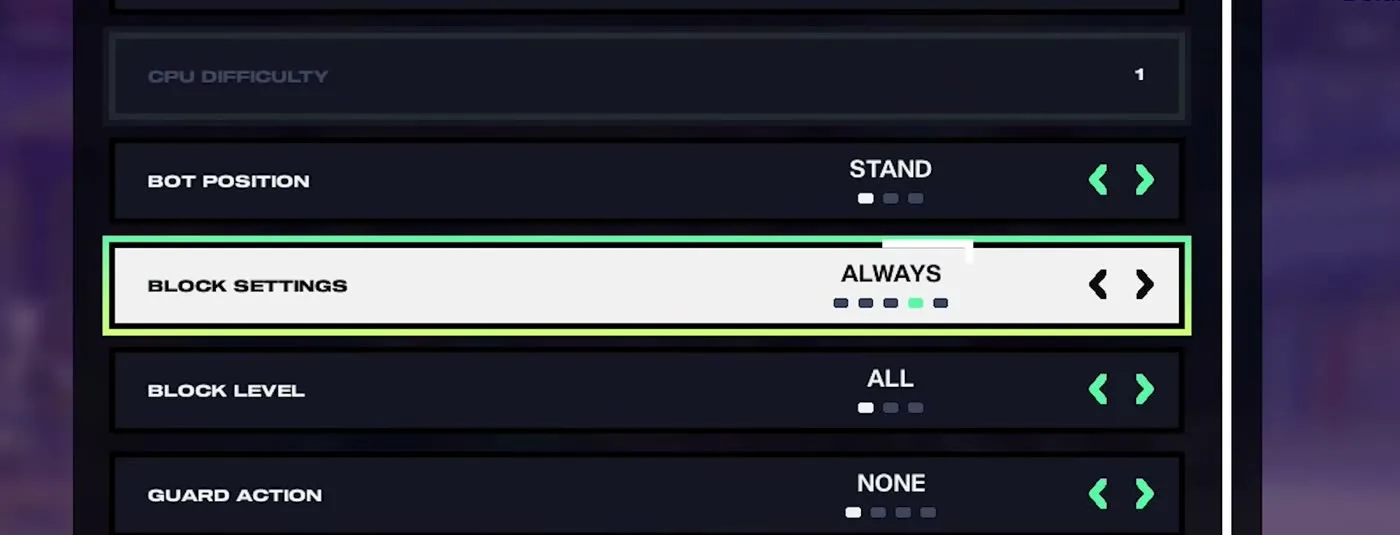
While you’re in there, note the two other options next to it. Guard Action is what you’ll use later to check whether your pressure is actually safe — set it to a reversal and the dummy will punish you the moment you leave a gap. We’ll come back to that.
1. Light, light, command dash, grab
This is the bread and butter. It carried me all the way to Grandmaster and it is still the first thing I’d put in a new Vi player’s hands.
Light into a second light, then command dash, then grab. From there you get a ground bounce and you can take it into super.
Why it works when other versions don’t
Here’s the part that matters, because it explains why you can’t just do this off any string: you cannot dash and grab out of most sequences. Try heavy into dash — it doesn’t work. The recovery doesn’t let you get there in time.
But light into an added light makes Vi do a three-piece, and the way that ends leaves the opponent sitting in exactly the right spot for the command dash to connect into the grab. It isn’t that lights are magic — it’s that this specific ender puts them at the right distance and the right timing. That’s why copying the input matters more than improvising with it.
It also does a genuinely stupid amount of damage for how easy it is. If you only take one thing from this whole article, take this one.
2. Crouching light into double dash (the drill, not the tactic)
I’m including this one with a warning attached, because I’d rather you learn it correctly than learn it as a habit.
Crouching light into a double dash, repeated. It looks genuinely horrible to deal with — you’re constantly in their face, constantly resetting, and it makes low-rank opponents freeze up.
But it’s unsafe, and here’s exactly how it loses
They can mash light and hit you out of it. They can also just grab you. In the video you can watch Caitlyn whiff against it — but only because I’m doing it fast enough. The moment I add even a small delay, Shiaki interrupts it cleanly.
That “small delay” is the problem, because online you don’t control your delay. A bit of lag and your perfectly-timed loop becomes a gap, and a gap against anyone decent is a free punish. So treat this as what it actually is: a speed drill for your double dashes, not a plan.
Worth the reps anyway, because Vi’s double dash is the foundation of tips four and five. Get comfortable here and the good stuff gets much easier.
3. The bait: light, medium, heavy, dash, light, medium
This one messes with people’s heads, and it’s my favorite tool on the list.
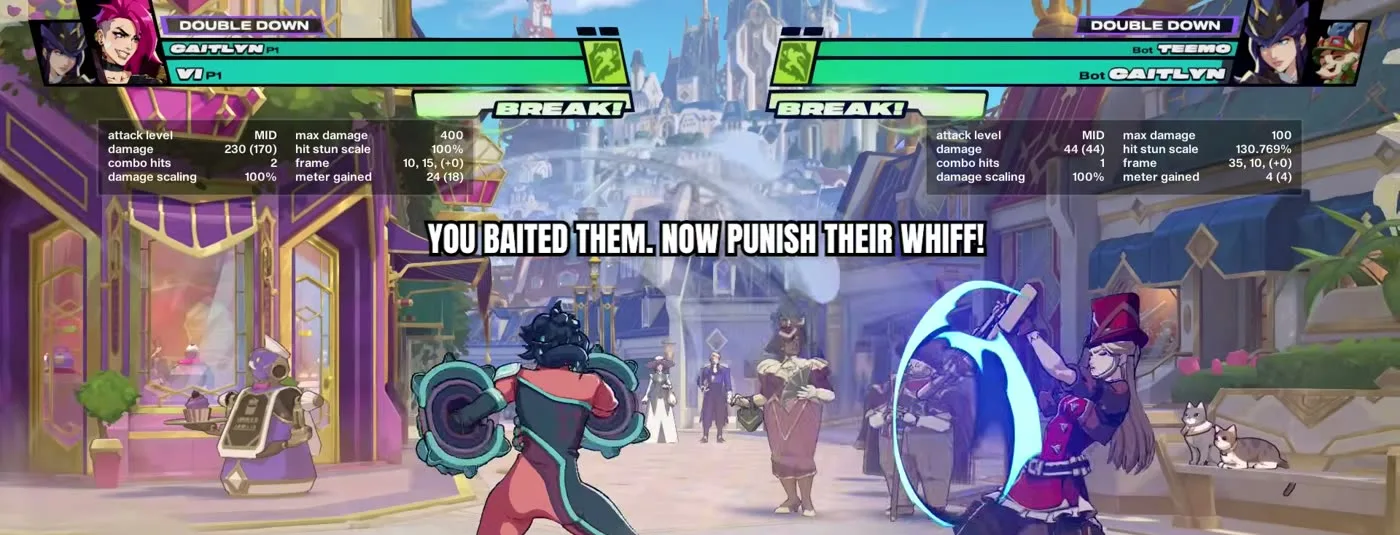
Light, medium, heavy — then forward dash, light, medium. You end up at minus 9, which sounds bad until you see the other half of it: the string also pushes them back. You’re negative, but you’re out of range.
Why being minus is the point
Your opponent reads the situation correctly — Vi is negative, it’s their turn, they should press a button. So they do. And it whiffs, because the pushback moved you outside their range.
Now you punish. Set the dummy’s reversal to a medium and you can watch it happen: she presses right after the block ends, comes up short, and you just wait and press medium for a clean whiff punish into a full combo. The punish does more damage than finishing the original string would have.
Light works too if you prefer it — you have to step in for a beat first, then press. Either way the pattern is the same: be patient, let them commit, take the turn back.
4. The sandwich: light, medium, heavy, assist, double dash
Every character should learn some version of this, but it’s especially strong on Vi because her double dash covers so much ground.
Light, medium, heavy — call your assist — then double dash.
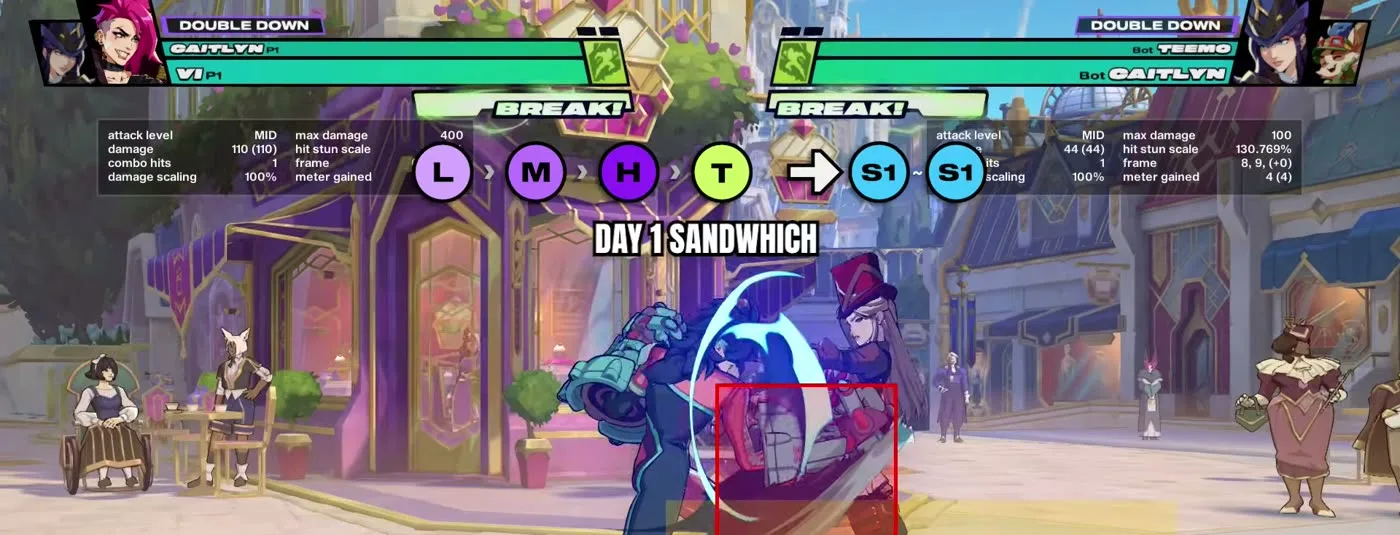
The double dash is what makes it work. It buys you the space to keep going with Vi while your partner is already committed and ready to tag in. So you can keep punching, then tag and go straight into a high-low. Or don’t — the point is that you now have two threats and they have to guess.
This is what Ekko and Yasuo players have been doing to you all season. Vi does it just as well. If you play with a regular duo partner it’s even better, because you can build the follow-up together — see the fuses guide for how your fuse choice changes what your assist can cover.
5. The early exit: crouching light, double dash, cross-up electric foot
This one is trickier, and it trips up a lot of people who should know better.
Start like the drill from tip two — crouching light into double dash — but instead of looping it, you jump over them and hit the air electric foot. It crosses up basically everybody.
Why it catches good players too
Because of what they’ve learned to expect from Vi. They’re braced for a long block string, or the light-light-double-dash-into-grab from tip one. Your habits set the trap for you.
Then you end all of that early. By the time they process “wait, Vi’s behind me,” you’re already over them, crossing back up on the original side. They’re a full beat behind and there’s nothing to do about it.
Follow-up is simple: dash up and go into light, medium, heavy and your normal sequence. That plain version alone did 378 damage — close to half of Caitlyn’s health, off a mixup, with no optimization at all. There’s more available if you want it.
The electric foot is worth understanding on its own, because it’s doing more than one job here. I broke down its inputs, its range and its weaknesses in 3 simple Vi mechanics — including the important detail that it’s still a jump-in, so it can be anti-aired.
6. Corner pressure: low into forward heavy overhead
You have them in the corner, you’re out of ideas, and you’re just mashing at a block. This is the answer.
Hit low, then forward heavy for the overhead. That’s a genuine high-low mix: they have to block low then high, and reacting to both in that window is not realistic.
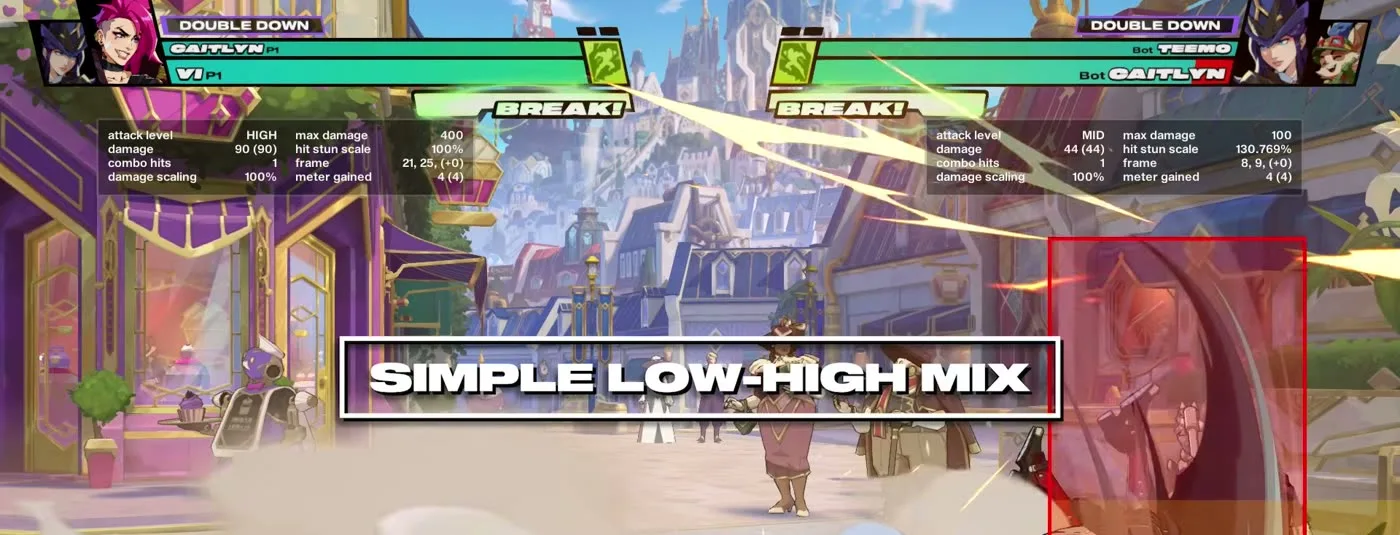
When the overhead lands, link it into your ground hit and take it to super. This is at its best as a closer — they’re cornered, they’re on low HP, you just finished a combo and need one more opening. The low-high gets you there and the super finishes it.
It’s not corner-only, either. I use the same mix mid-screen just to keep people from settling into one block height.
7. Tick throws — learn this one today
This is the most important concept on the list, it applies to every character in the game, and every pro is already doing it to you.
Instead of running your light-medium-heavy string when they’re blocking, you press one button and stop. Then you walk up and grab them.
That’s it. That’s the whole thing.
Why stopping beats continuing
A blocking opponent is waiting out your string. They’ve settled in. The moment you stop early, their defense is still holding block — and block does nothing against a throw.
It’s most brutal after an assist lockdown. You’ve got them pinned, you’re right in their face, and instead of the pressure they’re bracing for, you just take the grab. Off that you get a full combo, your OTG and your super — or if your assist is back up, call them in and go into whatever route you like.
The part that makes it safe
Here’s why you can throw this out without fear. If they don’t fall for it and try to press a button instead, you’re still in range — and your light is 6 frames, which is faster than what they’re pressing. You win that exchange.
Worst case, you both end up back in neutral, which costs you nothing. And your crouching medium reaches from there too, so the clean rule is: if you go for a tick throw, follow it with a crouching medium. You’ll win the trade or you’ll reset the situation. Either outcome is fine.
Standing light or crouching light both set it up. You can even mash the crouching light and then go for the grab.
The one that matters most
If you learn one thing here, learn tick throws. Not because it’s the flashiest — it is by far the least flashy thing on this list — but because it fixes the actual problem.
The reason your pressure stalls isn’t that your strings are too short. It’s that you only have one way to end them, so a patient blocker just waits you out every time. A throw makes blocking a losing option. The moment they have to respect the grab, everything else on this list opens up, because now they’re guessing instead of holding back.
Honest caveats
- Tip two is a drill, not a strategy. I said it above but it’s worth repeating — crouching light double dash loops get mashed on, grabbed, and interrupted the second lag adds a gap.
- Minus 9 is still minus. The bait in tip three works because of pushback. Against a character with a long-range poke, that spacing might not save you.
- The cross-up is a jump-in. Tip five loses to a clean anti-air, the same way every jump does. It works on the read, not on demand.
- Tick throws lose to throw breaks. Once you’ve grabbed the same player three times, expect them to start teching it. That’s fine — that’s when tip one and tip six become free, because they’re now thinking about the grab.
- Frame data moves with patches. The 6-frame light and the minus 9 are current as of this patch. The reasoning outlasts the numbers.
What to practice, in order
- Tick throws (tip 7). Twenty reps of light-stop-grab. This one changes your win rate fastest.
- Light, light, command dash, grab (tip 1). Your default opener. Ten reps until it’s automatic.
- Double dash reps (tip 2). Pure speed work — you need this before four and five will feel good.
- The sandwich (tip 4). Get the assist call timing down so the double dash actually covers.
- The bait (tip 3). Set the dummy’s Guard Action to a reversal and practice waiting for the whiff instead of pressing.
- Corner low-high (tip 6) and the cross-up (tip 5). These are your finishers — learn them once the basics are automatic.
If you want a structured warm-up to hang these on, the 5 daily drills guide is the routine I actually run before ranked. New to notation like S1 or crouching medium? Start with numpad notation, then combo system basics, and the full Vi guide has her button-by-button breakdown.
The short version
- Set Block Settings to Always in the training room before practicing any of this.
- Light, light, command dash, grab — the bread and butter. Works because that specific ender leaves them positioned for the dash; heavy into dash does not.
- Crouching light double dash loops look scary but are unsafe. Use them as a speed drill only.
- Light, medium, heavy, dash, light, medium leaves you minus 9 but pushes them out of range — they swing, they whiff, you punish for more than the string was worth.
- The sandwich is light, medium, heavy, assist, double dash. Two threats, they have to guess.
- Crouching light, double dash, jump, electric foot crosses up because you ended your pattern early. 378 damage unoptimized.
- Corner low into forward heavy overhead is a real high-low. Link into your ground hit and super to close rounds.
- Tick throws: press one button, stop, walk up, grab. If they don’t bite you’re still in range and your 6-frame light wins. Follow with crouching medium.
Want me to look at your pressure?
Most of the time I can tell within one replay which of these seven you’re missing — it’s usually the throw. If you want that done properly, I run one-on-one sessions where we go through your own matches: book a session here.
Otherwise, come post a clip in the 2XKO Jungle Discord and tell me what you’re getting stuck on. And if you want the combo side of this — what to do once the pressure lands — I’ve got a full Vi combo breakdown and an Ultimate Vi guide on the channel. You can also check where Vi lands against the rest of the roster on the current tier list.