The reason most people stall in 2XKO isn’t that they’re practicing too little. It’s that they’re practicing the wrong thing for where they actually are. Bronze players grinding expert combo trials. Gold players who still haven’t turned pulse combo off. Platinum players who have never watched a single one of their own replays.
So this is the whole ladder laid out — Aspirant to Challenger — with what you should be working on at each stop, and just as importantly, what you can safely ignore until later. I climbed to high Grandmaster doing it in roughly this order.
Find your rank, do that section, then read one rank ahead so you know what’s coming. Here’s the full breakdown on video if you’d rather watch it:
One thing before we start: this is about what to practice. If you want the mechanics of how RP, placements and decay actually work, that’s a separate thing and it’s covered in the ranked system guide.
Aspirant — just have fun
Welcome to 2XKO. Aspirant means you’re brand new, and the entire purpose of this rank is to enjoy yourself. That’s not a throwaway line — it’s the actual assignment.
The one tip I’ll give you: duo with a friend. Everyone I know says the game is dramatically more fun with someone else than alone. And if you can get a duo and fight another duo, that’s the best experience in the game right now. Nothing else at this rank matters.
Iron — browse the roster and turn on pulse combo
Still about fun, but with a light assignment attached: try everybody. The roster is small but the personalities are wildly different — Braum is a big body, Ahri is fast and mobile, Teemo is a small fuzzy menace who throws mushrooms at you until you lose your mind. Don’t commit to anyone yet. Just see what’s out there.
Turn on pulse combo
At character select, press right trigger. A small pink icon appears at the top — that’s pulse combo, and it does auto-combos for you. Mash one button and you get a combo. Mash a different one and you get an ender that spends your super. It means you can play the actual game without learning a single combo route first.
Leave it on. You’ll be using it for several ranks, and that’s completely fine.
The thing that actually matters at Iron
Figure out how you have fun. Not which character — which feeling. Is it landing big combos? Out-reading people? Zoning someone out and watching them get frustrated? Rushing in and swinging? Playing off a teammate and nailing the tag?
This sounds soft and it is the most load-bearing thing in this entire article. That preference becomes the backbone of your gameplay. If you don’t find your version of fun early, the higher ranks will grind you down and you’ll quit the game complaining about it. Find the positive experience now and it carries you the whole way.
Otherwise? Mash. Genuinely. Everyone is making mistakes at this level and you’ll absorb the button timings by osmosis — oh, square is fast, circle is slow, wait, I can charge that. Don’t worry about break meter, assists or tagging yet.
Bronze — learn what the mechanics are
Bronze is about knowing the game’s systems exist. Not mastering them. Not even really using them. Just recognizing them when they happen to you.
- Tagging and assists. Hold A (X on PlayStation) to tag out. Hold back and press it to call your partner as an assist instead. Press again while they’re out and you can swap to them. It’s a tag fighter — this is the core of it.
- Super meter. The bars at the bottom. Supers cost one. Every character also has a level 3 with a full cinematic and something dramatic attached.
- Break meter. Fills slowly, and your partner comes in to break a combo for you. Important detail: you can’t break for yourself. If you’re Vi and Jinx is your partner, Jinx does the breaking. Save it for combos that will actually hurt.
- Fuses. They change how your whole team plays — closest comparison is a keystone rune in League. 2X Assist lets you call twice, Freestyle lets you tag in and back out for mixups, and so on.
- Blocking high and low. Hold back to stand block, down-back to block low. Some moves only hit one. Learning where a move comes from is the entire foundation of defense.
- Push block. Forward + X while blocking shoves them off you, and you can tag out of it.
- Wake-up options. Off a knockdown you can get up neutral, tech roll back, tech roll forward, or hold an S button for a wake-up attack that knocks them off you.
- Parry. Costs one meter, stops their attack cold and hands you the turn. The window is tight.
You do not need to practice parries at Bronze. You just need to know what happened when someone stops your attack with a flash of effects. Recognition first, execution later. The fuses guide and combo system basics cover a lot of this in more depth when you’re ready.
Go do the tutorial — it pays you
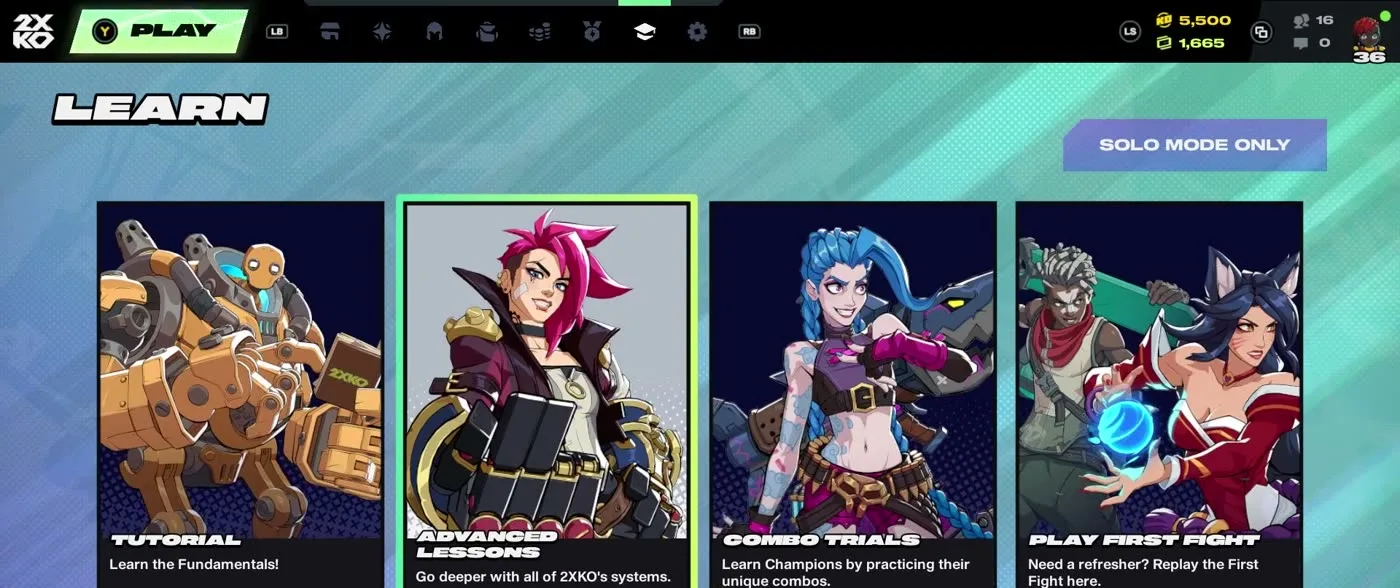
Head to the Learn tab and complete the tutorial. Two concrete reasons beyond the teaching:
- It hands you a pile of credits — the final lesson alone gives 50.
- It’s how you unlock fuses, including 2X Assist, which is one of the best assists in the game.
Then do the beginner combo trials for your character. Only the beginner ones — that’s the bare minimum here. The game literally shows you the inputs on the left. Light, light, light. It combos. It tells you good job. That’s how you start learning what your character does.
Advanced Lessons are also worth doing when you’re ready. Expert trials are not your problem yet.
One more Bronze tip: when you pick a fuse, take Double Down. The game marks it “Recommended” and it’s right — combining your super with your partner’s is simple, satisfying, and gets your partner out onto the screen.
Silver — this is where you actually start learning
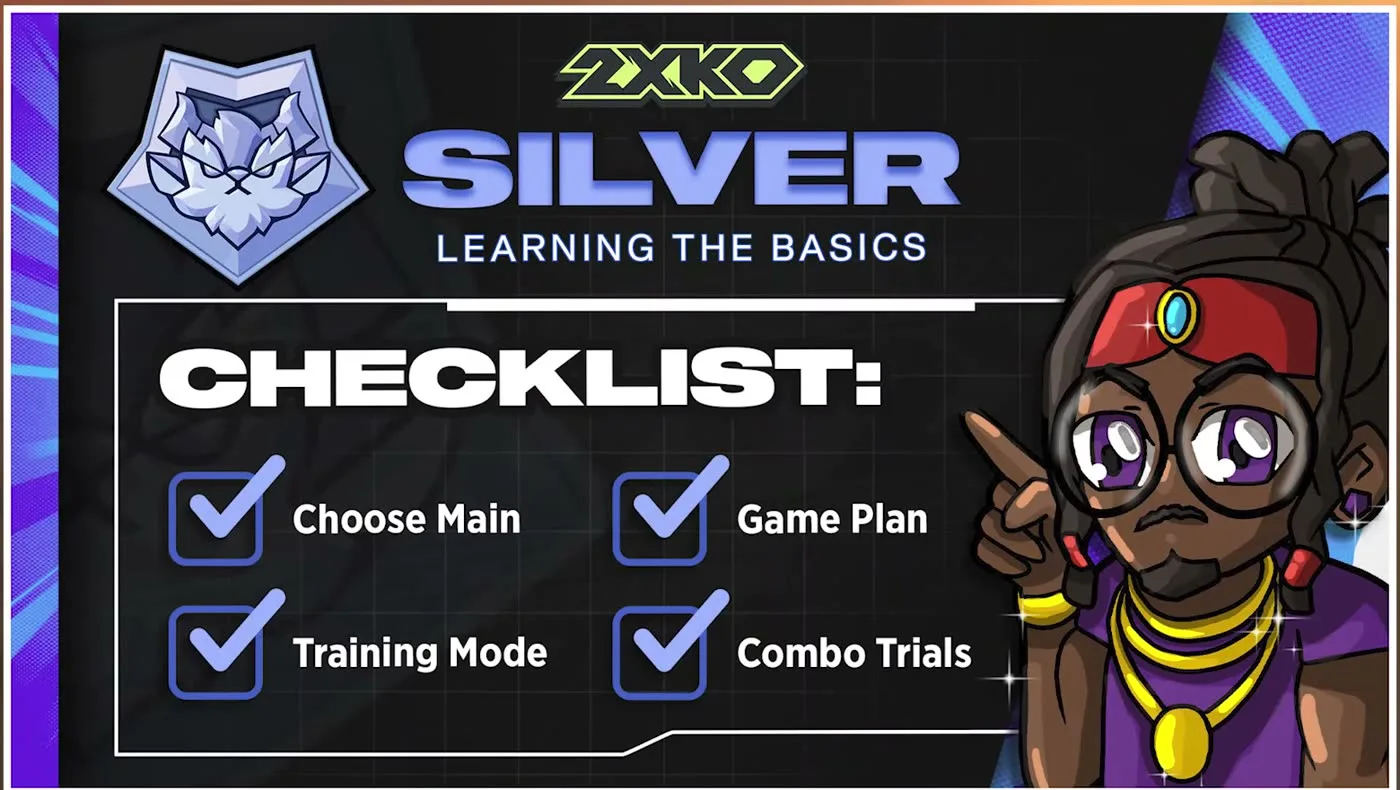
Keep pulse combo on. I mean it. Unless you’re coming from other fighting games and already understand combo systems, leave it alone — combos are not what you should be learning right now, and pulse will carry you to around Gold on its own.
Learn what training mode is
Not just for combos. The feature that matters is recording. Go to recording, pick a slot, hit record, and play as the opponent doing whatever you want. Hit playback and the bot repeats it exactly.
That’s how you deal with nonsense. Something beat you online and you don’t know why? Record it, play it back, and solve it in the lab until the answer is muscle memory. This single feature is the difference between people who improve and people who just log hours.
Pick a main and stop shopping
Solidify your team and your fuse. Three or four characters is the ceiling; one or two is better. There is so much detail in this game that spreading yourself across the roster means you never learn any of it properly. One-tricking a team is how you actually get good.
Read the command list
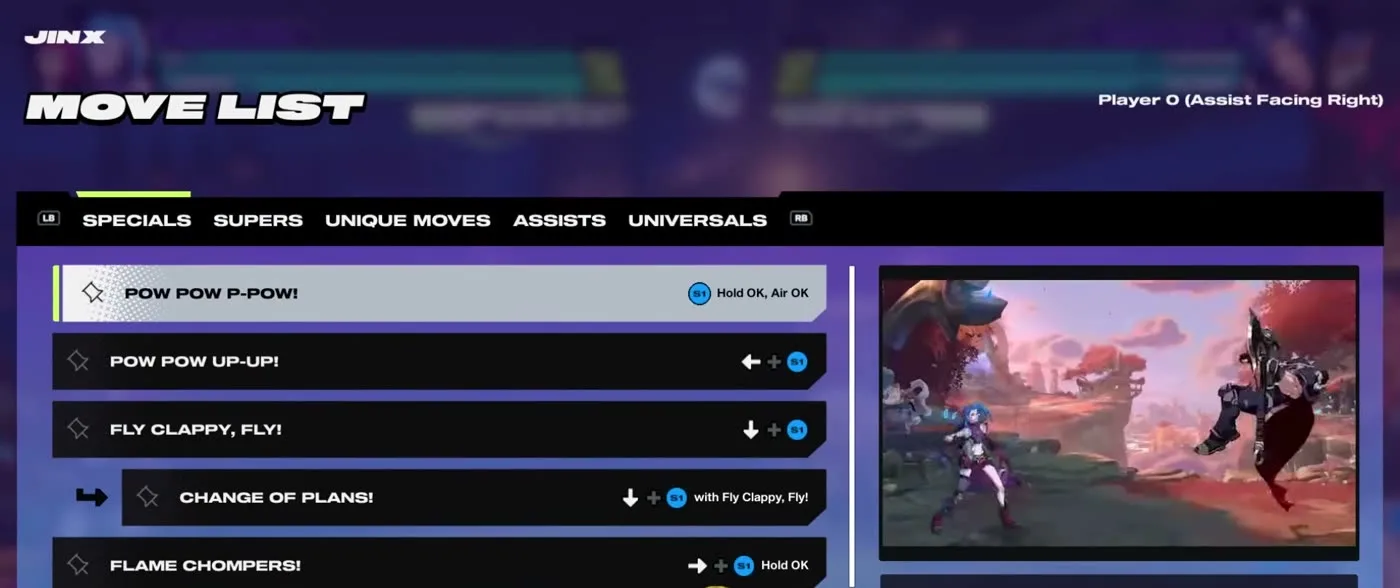
Go to Home → Move List and actually read it. It tells you the input, whether you can hold it, whether it works in the air, and — unusually generous for a fighting game — the move’s properties. This stuns. This knocks up. This causes a hard knockdown.
I found out embarrassingly recently that Jinx has a slide on a diagonal light input. Her normal lights have basically no range, so it’s a genuinely useful way to get in — and I’d never have found it if I hadn’t read the list. Go read yours.
Build a game plan
Every character wants something specific. Jinx wants to run away, throw traps and shoot missiles. Vi wants to be in your face. Find out what yours wants, then find the tools that get you there — if I’m Vi against a zoner, I’m not sitting there holding block, I’m using her double dash, which goes through projectiles and through the character.
Then build a team where your partner covers your weaknesses. Vi can’t get in? Charge a punch, call Jinx, and now it’s a zoning war on my terms. They’re rushing Jinx down? That’s Vi’s job. That’s the whole point of a tag fighter.
The biggest mistake in Silver
You have a partner and you’re not using them. I watch people play half a match without calling an assist once. Watch the cooldown — it comes back fast. Watch your health bar and tag out when you’re getting low. If you punish their assist it stays gone longer, but at this level people rarely punish it at all, so just keep calling.
Gold — the most important rank in the game
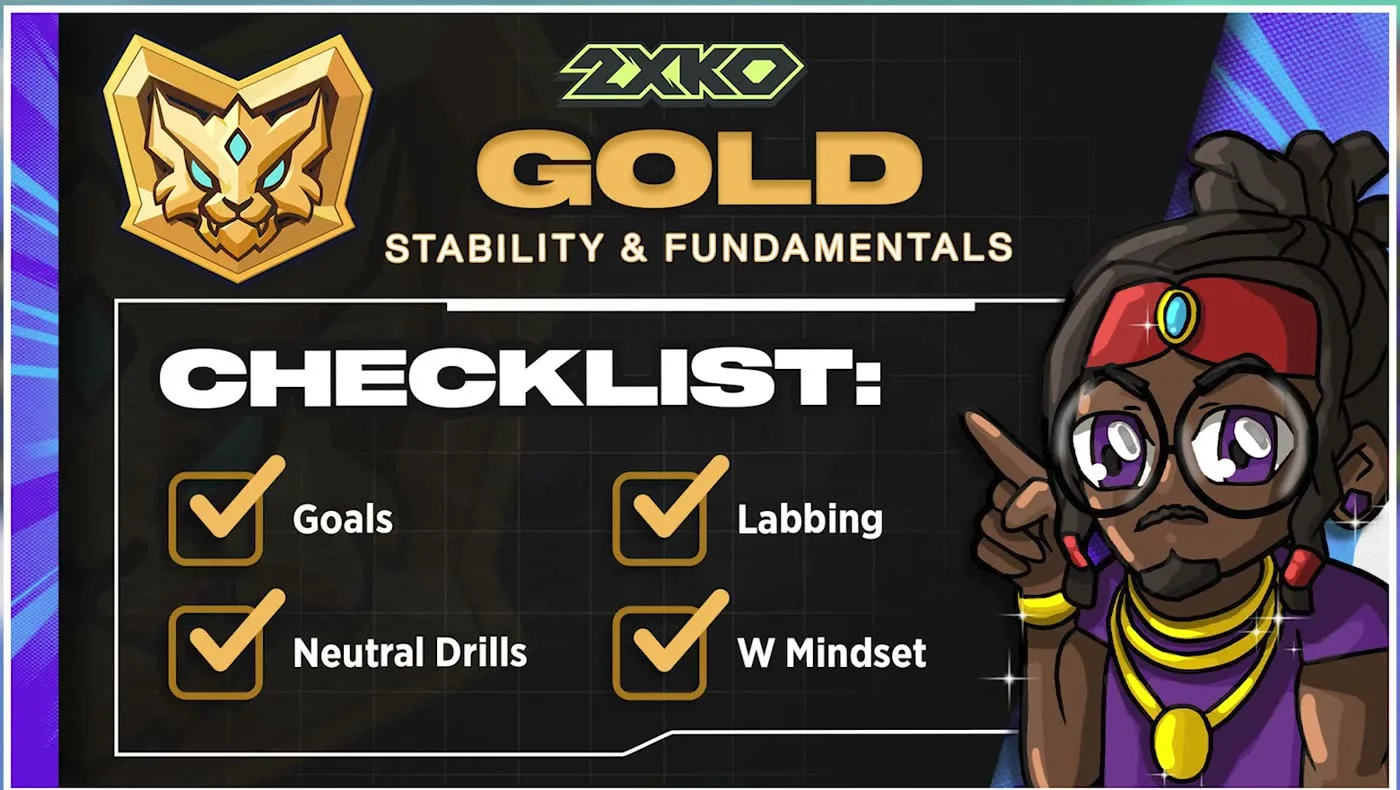
Most players are going to live in Gold. That’s normal — it’s the standard in basically every competitive game — and if you’re here you should feel fine about it. You can play the game with other competent people.
Make the decision
Red pill or blue pill: do you want to get better, or do you want to play casually? Both are completely fine. What’s not fine is failing to pick, because that’s how people end up frustrated and quit.
If casual is the answer, set a small goal and stick to it. Do your dailies, play with a friend, three matches, an hour, whatever. Then stop. Don’t overextend.
And here’s my honest, slightly harsh take: if you’re a casual player, get out of ranked. This is the single biggest source of misery I see. You queue ranked without any intention of improving, you run into people who are actively trying, you get stomped, and then you’re angry at the game. Play casuals. They exist for this.
If you chose “get better”
Start playing with pulse combo off. This is the rank to test it.
Then lab combos — but keep the bar embarrassingly low. Take whatever the auto-combo was doing for you and learn to do it manually. Something like light, medium, heavy, minigun, missile. Then do it three times in a row. That’s the whole drill.
The point isn’t the combo, it’s the muscle memory. No pro is thinking “okay I got a hit, what’s my route again.” It’s a reaction. Reactions come from repetition of simple things, not from memorizing hard things.
Set up real drills
Struggling with something specific? Record it and grind it. I set the bot to throw Ahri’s super and practiced parrying it — took me eight attempts before I got the timing, and now I know it. That’s a drill. Do that with whatever is beating you.
You can also turn on the display settings — hitboxes, hurtboxes, throw range, frame data. Green box is throw range, red is your hitbox, blue is their hurtbox; when red touches blue, they get hit. It’s genuinely eye-opening (some of Vi’s lights have almost no range at all), but it’s also overwhelming, so it’s fine to leave this until Platinum. Honestly, most of the time someone has already labbed it and posted the numbers — it’s faster to look it up.
Use your meter
Common Gold problem, mostly a side effect of pulse combo: people sit on three bars and never spend them. Use it. Parry with it, spend it on damage in a key moment, cash it in with Double Down. Meter you didn’t spend is damage you didn’t do — you’re losing games this way.
Adopt a winner’s mindset
On my streams the scoreboard says W and L, but it stands for Win and Learn. That’s not a cute slogan — a loss you extracted a lesson from isn’t a loss, and framing it that way is the single best defense against crashing out over this game.
Train your patience here, at Gold, where the problems are small. If you’re tilting at this level you will not survive Diamond and Masters, where you’re playing people who have put in hundreds more hours than you. It only gets harder. Build the temperament while the stakes are low.
Platinum — training wheels off, start grinding
Pulse combo is off now. Not “consider it” — off. You’re playing people who know their combo routes, their game plans and their mechanics, possibly better than you do. Free wins are done.
Start maximizing your fuse
Every fuse has depth the game doesn’t explain. The Double Down example: everyone knows you can chain your super onto your partner’s. Fewer people know about super tagging — call your assist, do your super, and tag while the super is still active. You swap sides mid-beam and get a completely free mixup off it.
One bar for a free neutral skip is absurd value, and it’s the kind of thing that separates Platinum from Gold. (I called this out in my alpha stream before it caught on and nobody listened at the time — now everyone’s doing it.) Whatever fuse you run, go find its version of this.
Learn the combo rules
Damage starts mattering here, and optimizing means knowing the limits. Per combo you get:
- One wall bounce
- One ground bounce
- One tag launch
Build routes that use all three. Also start learning alternate routes and weird hit confirms — because at high level you rarely get a clean hit. You get a scrappy one, and you need to be able to convert from almost anything. Vi’s double-tapped medium slam for catching people out of the air is a good example of the kind of thing you want in your pocket.
Think about win conditions too. As Vi I want them in the corner — so if my standard route would carry them out of it, I use a different one that keeps them there. That’s the Platinum-to-Diamond level of thinking.
Learn mixups
If low doesn’t work and high doesn’t work, how are you getting the hit? Mixups are the answer — switching between low, high, grab and left/right. If they’re blocking too much, grab them. If they’re blocking one side, get to the other.
The universal starting point: every character has an overhead. Go low, then overhead. That’s a mix, and it works on the entire roster. My Vi-specific version of this is in 7 Vi pressure tools if you want a worked example.
Finally: complete every combo trial your character has, expert included. The trials don’t measure your growth, but people at your rank can do them, so you should be able to as well.
Emerald — mastery, and a real defense
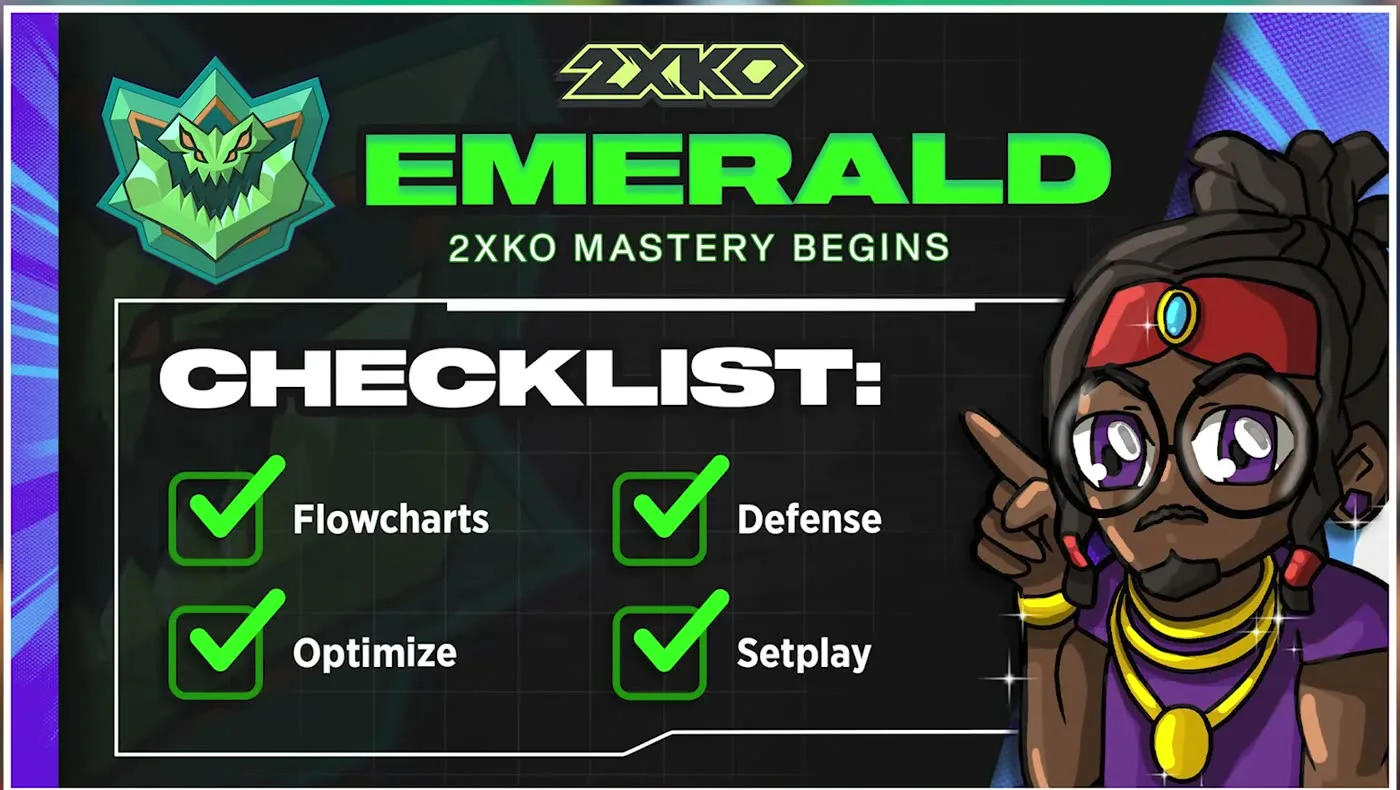
Everything should be starting to feel second nature. If I asked you for your best mix setup right now, you should be able to do it without thinking — that’s the bar. The reason it matters: once your own tools are automatic, your attention frees up to think about your opponent. That shift is what Emerald is.
Chain your tech together
In Platinum you learned super tagging in isolation. Here you learn to super tag off a push block — stacking separate pieces of tech into one sequence. That’s the skill: not learning new things, but combining the things you have.
Know your options in every state
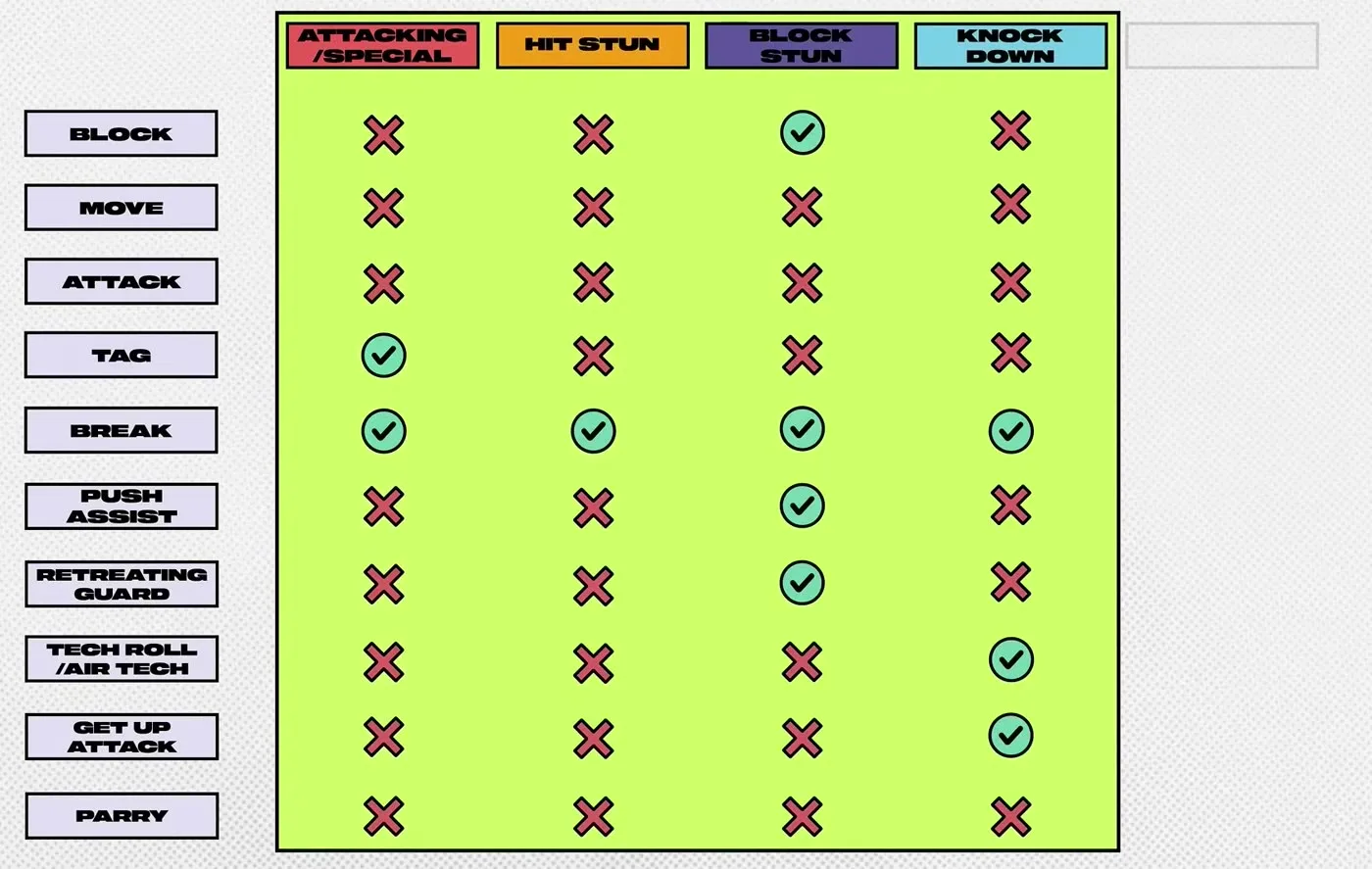
This chart is worth internalizing. It’s the answer to “what can I even do right now,” and the shape of it tells you a lot: Break is the only option available in every single state. That’s why it’s your emergency button and why spending it carelessly hurts so much.
You should also stop getting hit by dumb things, which means learning the small stuff:
- Jumping takes 4 frames. Turn on the frame meter and you’ll see it. So holding back and jumping away is not safe — if they time it inside those frames, you get interrupted. Match someone’s wake-up jump and you’ll beat it.
- Tech rolling is punishable. Grab someone’s roll and the game literally prints “punish.” It’s a true combo because they chose to roll. Build your setups so that teching is the wrong answer.
A concrete example: as Jinx, hammer into trap setup, then back up. If they tech roll, you grab it. If they wake-up attack, you block it. If they roll backwards, your medium catches them. If they do nothing, you walk back in and grab or go into low-high. One setup, every option covered.
Break with purpose
Until now you’ve used break to escape combos reflexively. Now start tracking it. Break early and deliberately and you might get it back in the same match, or even use it multiple times in a set.
The real decision is break versus saving for Fury. My default lean is to break and save the character, because keeping your partner alive keeps your assist and your fuse available — if they’re dead, a lot of your toolkit goes with them. But Fury is genuinely strong and high-level players make comebacks with it constantly. Work out which fits your team.
Diamond — get outside your own head
At Diamond you know the game. Your combos, your routes, your characters. The thing that moves you now is expanding your knowledge outside of your own matches.
Watch VODs — yours and other people’s. How is a Daphne, a Lefin, a SonicFox handling your team? There’s always something to take. I play Vi/Jinx, which almost no pros run (Jinx gets overshadowed by Teemo), so whenever I do spot one I’m watching closely and taking notes.
Beyond that:
- Optimize your enders. If the super won’t kill, is it better spent elsewhere? Ending in Limit Strike for a setup or a mixup is often worth more than the raw damage. Warwick players — can you route for more bloodlust? Teemo — can you fit the shroom loop in mid-combo?
- Set play. Land a hit, call your partner, bring the point character back, and land in a specific corner setup you’ve built on purpose.
- Total resource awareness. You should know mid-combo whether you’re reaching level 2, whether spending super now costs you your parry later, and where your assist cooldowns are. All of it, all the time.
- Character-specific slime. Cheeky setups and cross-ups only someone with real mastery can pull off. You’ll see them constantly at this rank, so you need your own.
Also: duo play peaks here. When both people actually know what’s happening — breaking for each other, finishing each other’s combos — it’s the most fun the game gets.
Master — polish, then go compete
You’ve mastered the game. What’s left is player-versus-player refinement: not dropping combos ever, knowing exactly what to do, and being able to spectate a match and call what happens next before it happens.
At this point you’re beating the opponent, not the game or yourself. You have the potential to beat anyone — and I mean potential, not a promise. Nobody hits Master and starts beating Lefin. But the ceiling is now genuinely open.
The assignment here is simple: enter online tournaments. Ranked has stopped teaching you. Bracket pressure is a different skill and the only way to get it is to feel it.
Grandmaster — the real top, and some honest math
Congratulations, you’ve hit the highest rank achievable by a person with a life.
Here’s what I mean. Challenger is the top 100. When I checked, the player sitting at rank 100 had 1,079 RP. I gain about 3 RP per win. I have a job, a family, a girlfriend, and I make these videos. There is no version of my week that closes that gap, and the bar only climbs.
So treat Grandmaster as the real summit. You’ve beaten the game and everyone in it who isn’t grinding full-time. Personally I think the cap should be top 500 to make it meaningful for more people, but either way — be proud of this one. Getting here meant surviving a lot of Yasuo, a lot of Ekko mixups, a lot of Teemo spam, and probably a controller or two.
Two things start applying here. Tier lists begin to matter — not much, and mostly at the margins around neutral skips, but a little. And more usefully:
- Compete for real. Not “try a tournament” — go to all of them. Tuco Tuesdays, the Breakout Series, TNS on Thursdays, your locals, majors. There are more brackets running than people realize.
- Start creating. You understand every character in this game, including ones you’ve never touched, better than a new player ever will. That knowledge is worth something to somebody. Help a duo. Teach someone. Give it back.
Challenger — go beyond the game
If you’re Challenger, ranked has nothing left to give you. Pro play, tournaments and content are the obvious next steps, but the real advice is this: monetize what you built.
You spent an enormous amount of time getting here. Treat that as an investment rather than a sunk cost — stream, get sponsored, sell something, invest in the gear that makes it viable. You have proof of skill that almost nobody has.
And you have a voice. Most people’s feedback disappears into the noise; yours doesn’t, because you can say “I’ve played this many games, here’s what I’m seeing” and Riot will actually listen. Use it on something productive — real feedback, real community building — not the usual Twitter nonsense. Then turn around and help the ranks below you.
The pattern underneath all of it
Read the ranks back to back and the shape is obvious. Early on you’re learning what exists. In the middle you’re building muscle memory so your own tools stop taking up attention. After that you’re studying your opponent. And at the top you’re working on yourself — patience, consistency, and what you do with the knowledge.
Almost everyone who’s stuck is doing a stage they haven’t earned yet, or repeating one they finished a long time ago. If you’re not sure which, look at the two ranks around you and be honest about which list you can actually tick off.
Honest caveats
- Season 0 RP is weird. Gains have been generous and people are ranking up without much resistance, so your badge may be running ahead of your skill. Going forward Gold should settle as the real standard.
- These are guidelines, not gates. If you’re coming from other fighting games, skip ahead freely — turn pulse combo off at Iron if you want.
- The 1,079 RP figure is a snapshot. It was accurate when I checked and it climbs constantly. The point isn’t the number, it’s the gap.
- Frame data moves with patches. The 4-frame jump and the specific interactions are current for this patch; the reasoning survives, the numbers may not.
- Tier lists barely matter until the very top. Below Grandmaster you can win with anyone, and blaming your character is almost always the wrong diagnosis.
The short version
- Aspirant: have fun, duo with a friend.
- Iron: try the whole roster, turn pulse combo on, work out how you enjoy fighting games.
- Bronze: learn that the mechanics exist. Do the tutorial for credits and fuse unlocks. Beginner combo trials only. Run Double Down.
- Silver: discover training mode and the recording feature, pick a main and stop shopping, read your command list, build a game plan — and use your assist.
- Gold: decide whether you’re improving or playing casually, and if it’s casual, leave ranked. Pulse combo off. Simple combos three times in a row. Spend your meter. Win and Learn.
- Platinum: training wheels off for good. Find your fuse’s hidden tech. One wall bounce, one ground bounce, one tag launch. Learn mixups — every character has an overhead.
- Emerald: your tools go automatic so your attention moves to the opponent. Chain your tech. Jumping is 4 frames and tech rolls are punishable. Break with intent.
- Diamond: VOD review, optimized enders, set play, total resource awareness.
- Master: stop dropping things, and start entering tournaments.
- Grandmaster: the realistic summit. Compete properly and start giving knowledge back.
- Challenger: go beyond the game — monetize it, and use the voice it gives you well.
Not sure which rank’s homework you’re actually on?
That’s the hardest part to judge about yourself, and it’s the thing a second pair of eyes fixes fastest. I run one-on-one sessions where we go through your replays and figure out which stage you’re really at — usually it’s not the one on your badge. Book a session here.
Free options too: come post a clip in the 2XKO Jungle Discord, work through the 5 daily drills, or build your own rankings on the tier list maker. If you main Vi, 3 simple Vi mechanics is a good next read.