TJPuma opens and closes this video with the same sentence, which is usually a sign that the person means it: “That’s the new meta of playing 2XKO right now. You have to just delay your hits.”
Everything else in the twelve minutes — the Jinx trap setup that people cannot parry, the Zap and monkey combination, the Vi and Jinx bread-and-butter he tells you to steal — sits on top of that one idea. Below is the whole set, broken out with the moments he flagged on screen.
The matchup, and why it is a good test
Vi and Jinx on Double Down against Senna and Warwick on Freestyle. The opponent’s badge said Emerald, but as TJ puts it, “his MMR like skyrocketed. More like Master level, because this guy really knew what he was doing with Freestyle and Senna.”
What makes it useful is that he is admittedly playing half blind. He says outright that he is new to fighting Senna and has no idea what is happening in several exchanges, and that Warwick’s frame data was changed enough that he no longer remembers what counters him. His words: “I’m just going off of vibes and fundamentals.”
That is the interesting condition. Anything that works here is working without matchup knowledge — which means it is a fundamentals answer, and fundamentals answers travel to matchups you have not learned yet.
The delay is the whole meta
Here is the string, and the important part is not the buttons:
- Light
- Crouching medium
- Delay. Wait. Hold up.
- Heavy
- Dash, command grab
He narrates the pause over the footage: “Look how delayed it is. You see that? I almost didn’t press heavy. I wish I could play in slow motion.” The delay is long enough that it looks like a dropped string.
Why the grab lands
The heavy is not the payoff either. The payoff is the command grab afterwards, and his read on why it worked is the useful bit: “He was so worried about me, like what I was going to press next, that he kind of forgot about the command grab, or maybe he just reacted really late.”
A delayed string forces the defender to keep paying attention. Attention is a limited resource. While they are spending it on when the next button lands, they are not spending it on which category of thing is coming — and the grab is a different category.
He arrives at the same conclusion from a completely different set of games in the Vi and Jinx meta replay breakdown, where the mechanical reason gets spelled out: 2XKO’s block windows are not lenient, so a defender holding a memorised rhythm is wrong the moment you change it.
Strong Vi setup: push block into a missile confirm
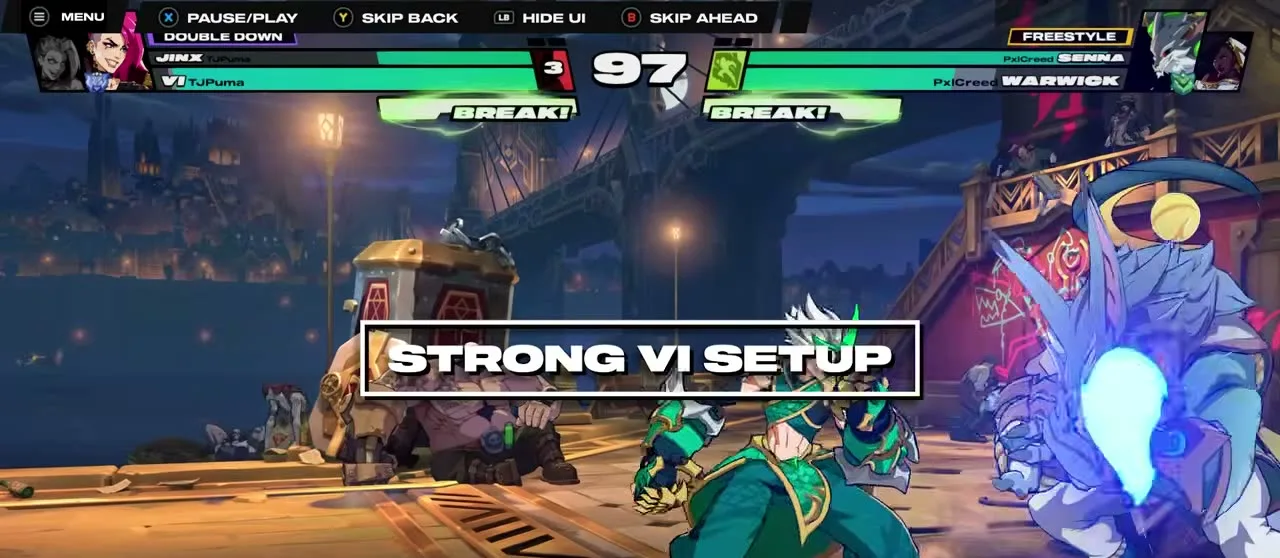
He push blocks out of pressure and immediately confirms it with a Jinx missile. Then comes a decision worth copying:
“Because they’re in the air, I can’t go for any fancy electric, so we’re just going to go for basic.”
He launches, charges S1 to leave them crumpled, and takes limit strike to guarantee the light he wanted. He then grades himself on it: it worked, but it traded, so he did not do it early enough.
Note how quickly the “no fancy electric here” judgement happens. That is not caution, it is recognising that the situation does not support the option. If you are still building that instinct, the electrics drills post covers when the charge is worth it and when it is actively costing you damage.
Down S2 beats everything at round start
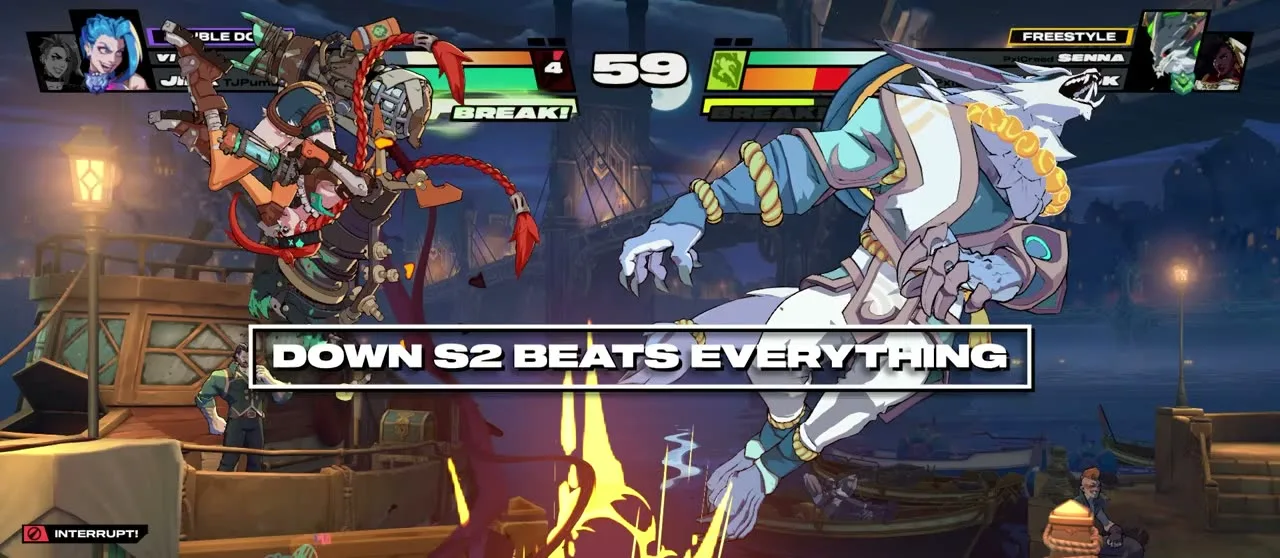
The context matters. He has just been parried, and rather than panicking he points out that Jinx is still full screen, so nothing has actually gone wrong: “I’m still here, down S2. Still works. Down S2 beats so many of the round start neutral options.”
Two things to take from that. The button is genuinely strong at the opening exchange. And a parry mid-screen is not a disaster when your other character is still holding the far side of the screen — the position is what saved him, not the read.
The Jinx and Vi combo he tells you to steal
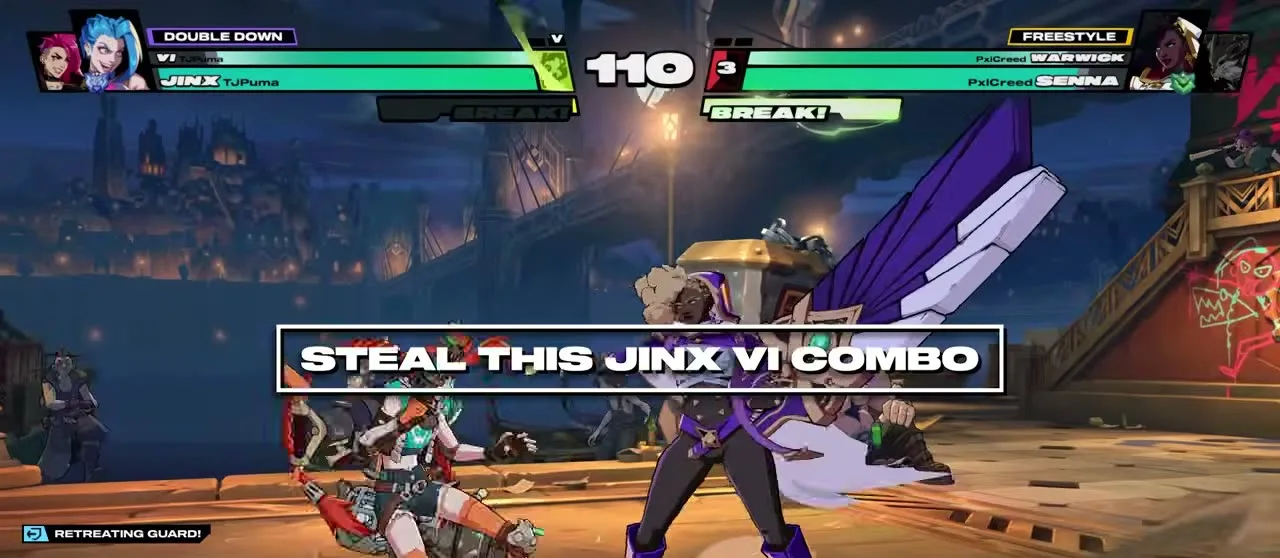
Off a minigun hit:
- Minigun connects.
- Call the Vi assist.
- As the punch connects, shoot the missile with Jinx and tag.
- Medium, heavy.
- Punches.
He is upfront that the medium is optional and that better optimisations exist. Then he explains why he does not use them:
“There’s way more better ways to optimize that, but that is just the most consistent. It always works on everybody, so I’d rather consistent and finish your combos than maximizing and dropping it and losing it.”
“It always works on everybody” is doing a lot of work in that sentence. A route that needs no character-specific adjustment is one less thing to remember at the exact moment you have the least attention available. There is a fuller version of this argument, with damage numbers attached, in three simple Vi mechanics.
Jinx trap and Zap tips: use Vi as a meat shield
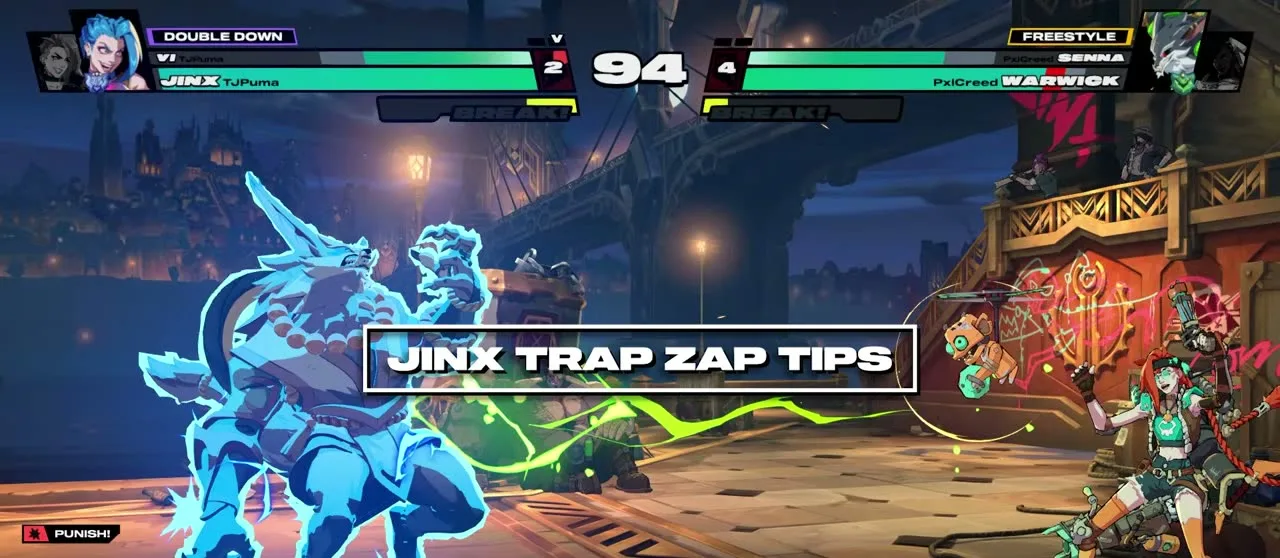
This is the most quietly ruthless idea in the video. He knows Jinx’s Zap is about to fill, so:
“Vi is just stalling. She is just a meat shield. I don’t care if she gets hit, punished, whatever. She is just keeping them away so I can get this trap out for Jinx.”
Deliberately spending your point character’s health to buy setup time is a Marvel-style resource decision that most players never make consciously. He is trading a currency he has (Vi’s health bar, mid-round) for one he wants (a placed trap plus a full Zap).
Zap through the monkey
The mechanical detail: “I zap through to make sure the monkey also gets ignited.” The Zap is not just a projectile here — routing it through the trap lights the trap on the way past, so one input arms two threats. He also holds the trap rather than igniting on placement, waiting until the opponent has walked into range.
That hold-versus-ignite decision is situational rather than a rule — there are plenty of spots where lighting it immediately is right. Three simple Jinx mechanics goes through the tradeoff, and the full Jinx guide covers her trap set generally.
The secret trap interaction
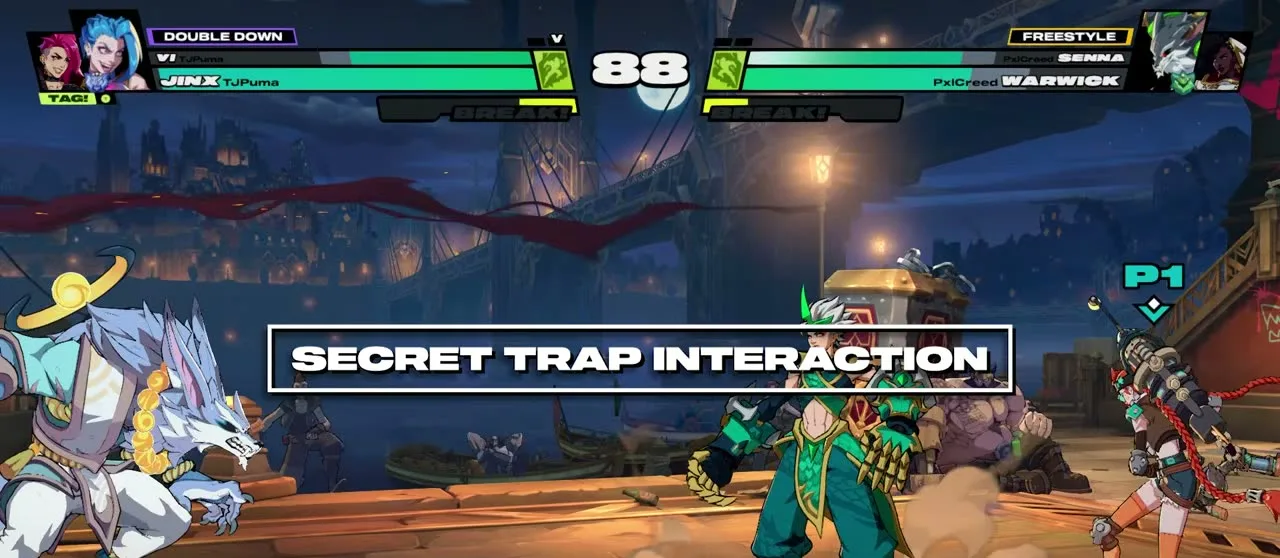
This is the piece worth taking to the lab. The setup, in his order:
- Vi anti-air, then a missile.
- Fully charge the Jinx trap, thrown forward.
- Back sway with Vi.
- As the trap is about to land, charge Vi’s command dash light.
- Vi hits the trap, which now travels as a projectile.
- Full crossup, then the trap detonates.
Why it beats parries
This is the actual value, and he is specific about it:
“You could parry the missile pretty easy. People parry the missile all the time in grandmaster and challenger stuff, but here he did not parry it, and it’s hard to parry this trap.”
At high level Jinx’s missile is a known quantity — good players parry it on reaction. A trap converted into a projectile by Vi’s dash arrives on a timing nobody has practised against, and it comes with a crossup attached, so the defender has to solve direction and timing simultaneously.
The conditions, and the honest caveat
It is not universal. He describes it as needing a very specific spot: Vi in one position, Jinx well back, and the opponents recovering. Outside that window the pieces do not line up.
And he drops it on camera. “So yeah, I messed that up completely. I don’t know why I delayed it or whatever.” He then shows the clean-up — light, medium, heavy, call Jinx back in to finish. Worth knowing that even the person who found the setup does not land it every time; treat it as a lab project, not a round-one plan.
Outread the Senna counter
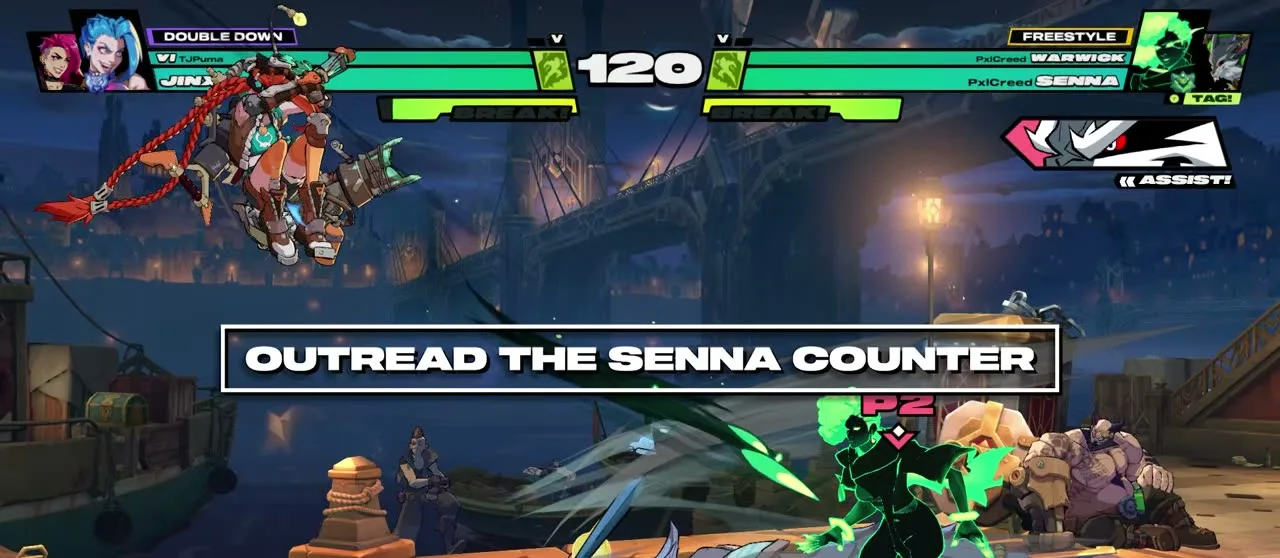
The read: “Round start, Senna’s been doing this anti-air gun into Warwick assist call consistently.”
The answer is deliberately unexciting. He lists what he could have done — waited, punished Warwick, run in, done something risky — and then says what he actually did: “I didn’t. I just been patient.” Jump, block, call the anti-air assist.
Spotting a repeated pattern usually tempts people into the maximum punish. Taking the guaranteed small win instead, three rounds running, is how a read turns into a match win rather than a highlight.
Smaller pieces worth having
Fully charged air heavy into air S2
After catching a jump-in: charge heavy, and the fully charged air heavy sends them straight to the floor, which sets up air S2. He calls it a nice little combo for maximum damage, and it does not require any charge timing beyond holding the button.
Senna’s projectile pulls you in
Genuine surprise on camera — one of her projectiles sucked him toward her. “Look at that. It actually pulled me into her. She doesn’t do that in League.” If you have not fought Senna much, expect her zoning to move you, not just chip you.
The Warwick matchup swings on priority
His summary: Warwick loves this matchup while he has fury, and hates it once Jinx gets her priority. Generalised: “Everyone hates zoners when they get their priority.” The matchup is not fixed — it is a race between his fury meter and your screen control.
Back dash sway to punish
He back dashes, sways under a Warwick slide, and punishes it. He also immediately says he wishes the follow-up light reached further: “It doesn’t need to be broken, just make it feel rewarding.” Fair criticism of a tool he clearly likes.
What to take to the lab
- Practise the delay first. Light, crouching medium, long pause, heavy, dash command grab. The pause should feel uncomfortable — that is the point.
- Lock in the consistent BnB. Minigun, Vi assist, missile plus tag, medium heavy, punches. Get it to the point where you never think about it.
- Route your Zap through a trap so one input arms two things.
- Build the secret trap setup slowly. Charged trap forward, back sway, charged command dash light. Expect to drop it — he does.
- Try down S2 as your round-start default for a session and see how much it wins outright.
- Watch one opponent’s round-start habit per set, and answer it with the safe option rather than the flashy one.
The training mode settings guide has the toggles that make these testable rather than vibes-based, and what to practise at every rank will tell you whether this is even the right thing for you to be working on right now.
The short version
- Delaying your hits is the headline. Light, crouching medium, wait, heavy, dash command grab.
- The grab lands because their attention is on timing, not on category.
- Down S2 beats a large share of round-start options.
- Take the consistent combo over the optimal one — dropped damage is zero damage.
- Vi can be a deliberate meat shield while Jinx builds Zap and places a trap.
- Zap through the monkey so both threats arm from one input.
- The charged-trap-into-command-dash setup is far harder to parry than a raw missile, but needs a specific screen position.
- Fully charged air heavy floors them and sets up air S2.
- Senna’s projectile can drag you toward her.
- Warwick wins the matchup with fury; Jinx wins it with priority.
- When you spot a repeated round-start habit, take the safe answer, not the flashy one.
One last thing
The set ends oddly. His opponent parries, and the game disconnects. TJ is careful to say it was not a rage quit — you do not rage quit off a successful parry — and then does something genuinely curious: he tries replay takeover on the disconnected replay to see how the round would have gone. It does not work. The replay simply ends.
A small thing, but worth knowing if you ever try to study a match that ended early: takeover has nothing to take over.
If you play this team, the Vi guide and Jinx guide cover the fundamentals underneath all of this, and seven Vi pressure tools is the natural next read if the delayed string is your favourite part.
Bring your own setups to the 2XKO Jungle Discord, or if you want someone to watch your replays and tell you which of your habits is costing you rounds, book a coaching session.