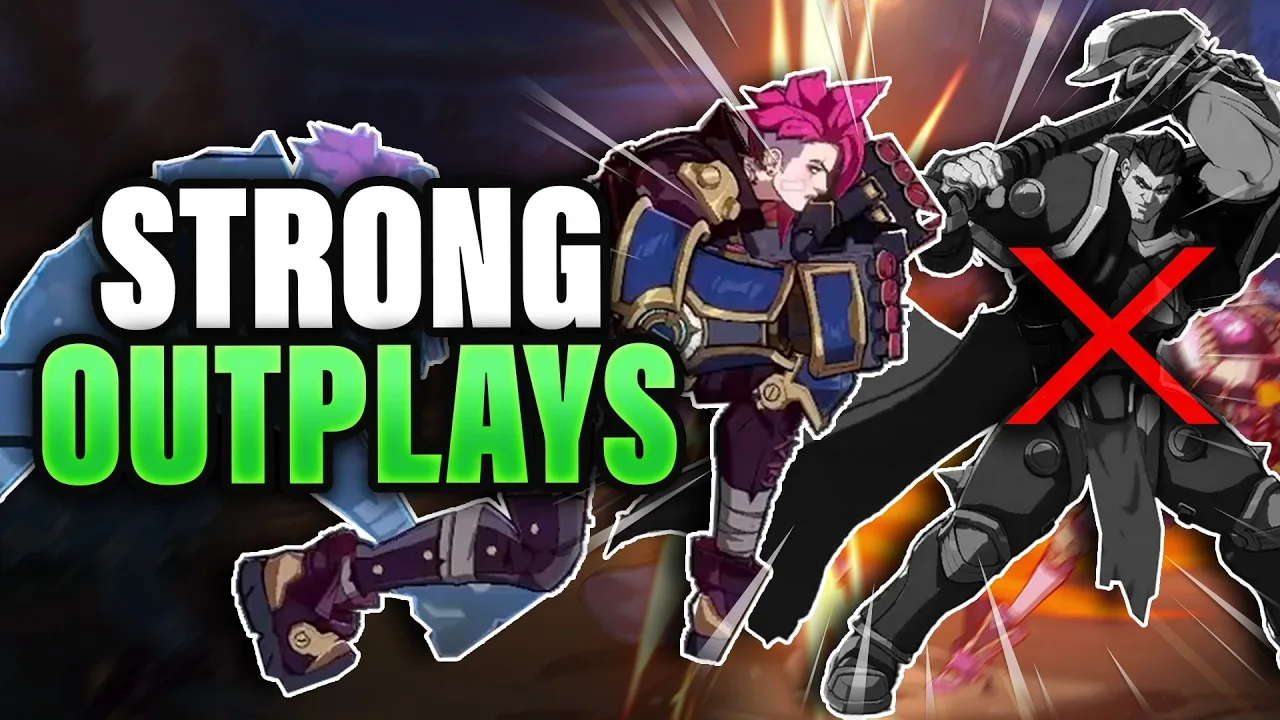
Most replay videos are highlight reels. This one is not. About thirty seconds in, TJPuma says the quiet part out loud: “I actually am not playing perfectly. I’m making a lot of mistakes, which is very relatable.” Then he spends twenty minutes showing you both — the Vi and Jinx tech that is quietly beating the current 2XKO meta, and the moments where he throws a won round away by getting fancy.
That combination is what makes it worth writing up. The tech is the part you can steal. The mistakes are the part that tells you which tech is actually reliable under pressure and which is just flashy.
The match, and why this format teaches more than a combo video
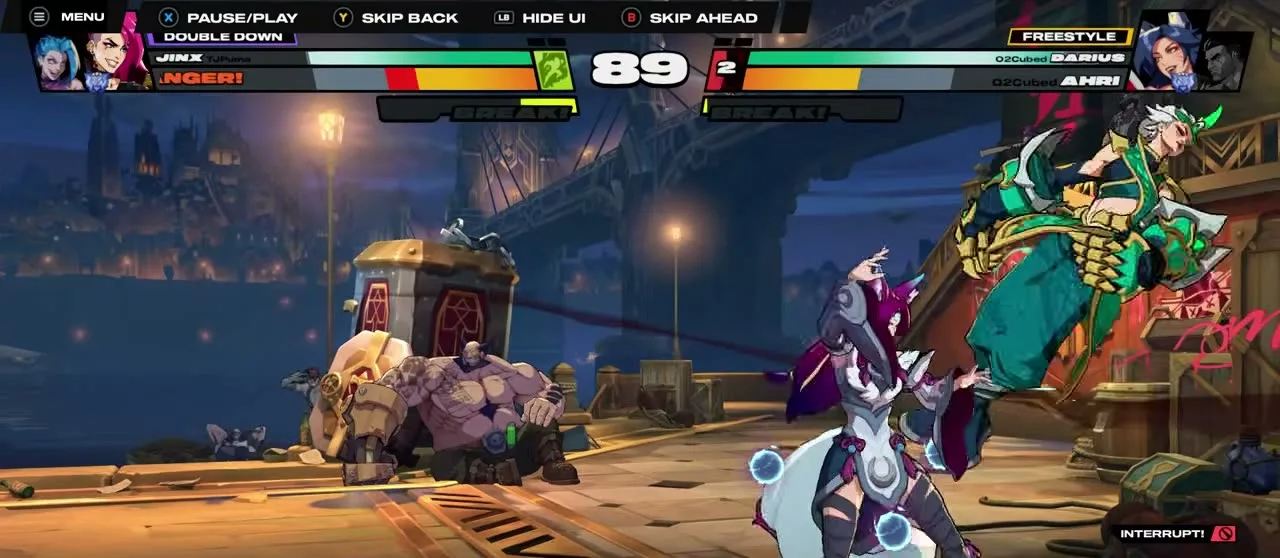
The set is Vi and Jinx on Double Down against Darius and Ahri on Freestyle — you can read both fuses straight off the HUD in any screenshot below. TJ is Master rank; he describes the games themselves as Diamond level, and he is careful to say so rather than dress them up.
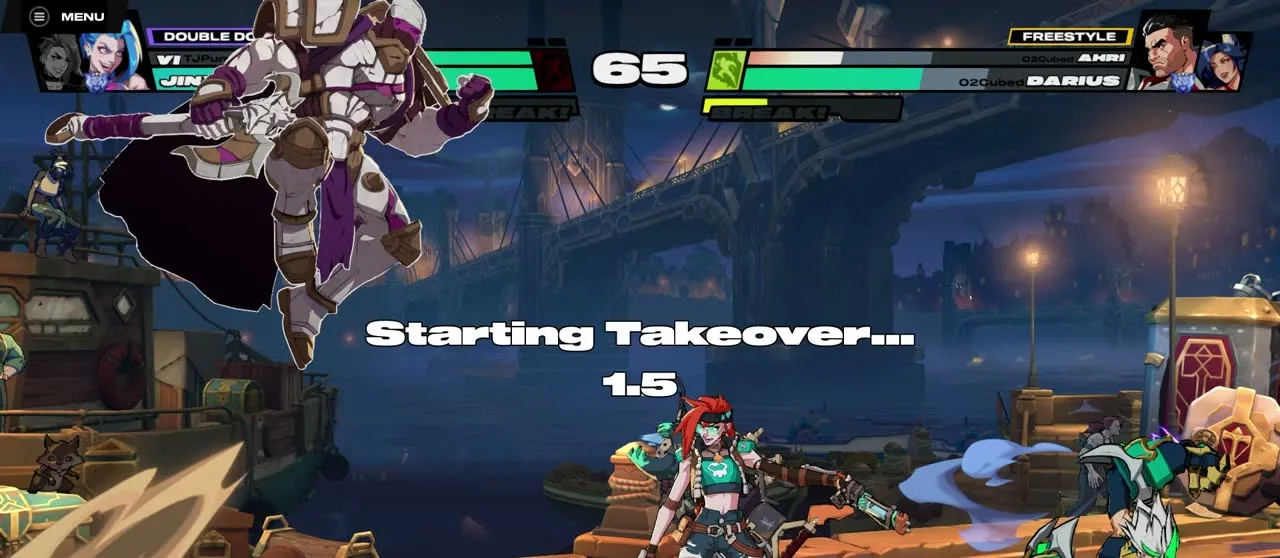
The tool doing the heavy lifting is replay takeover. Twice in this video he stops, seizes control of the replay, and actually performs the option he should have chosen. That is the difference between “I should have anti-aired” and knowing which anti-air button converts. If you are not using takeover on your own replays, it is the single highest-value feature in the mode.
The rule underneath everything else: stop fully committing
The first lesson arrives before the first minute is up, and it ends up being the spine of the whole video:
“It’s important not to commit fully. I notice I get punished the hardest when I fully commit to things.”
Watch how often that repeats in the actual footage. He baits a dash-in and shimmies instead. He walks up and does nothing. Later, when he does commit — a full double dash through neutral — Darius jumps and presses heavy, and there is nothing to be done about it. His words: “I feel like there’s nothing I can do cuz I’m fully committed to the dash already.”
This is not “play passive.” Every tool below is aggressive. The distinction is that each one leaves him an out if the read is wrong.
Delay your light into a crouching medium
This is the most immediately stealable thing in the video, and it costs you nothing to try tonight.
Why it works
Standing light into crouching medium, with a deliberate delay between them. In his words: “you usually catch a lot of people slipping… you’re catching their block timings off because this game isn’t lenient.”
That last clause is the mechanical reason. 2XKO does not give you a generous window to switch your block height or re-block after a gap. A defender who has learned the rhythm of the standard string is holding a timing, not reading a move. Change the rhythm and the timing is wrong.
Where it fails
A delay is a gap, and a gap is where reversals live. Against someone with meter and the willingness to use it, delaying your string is an invitation. Use it as a mix against players who block patiently, not as your default string against someone mashing supers on defence. He also notes the same crouching-medium trick coming back at him from the Ahri player later in the set — this is not a secret, it is just currently underused.
Charge the heavy instead of the route they expect
Here is the one he explicitly frames as new-meta tech. The expected Vi route after a sliding medium is heavy into minigun. Everybody at this rank has blocked it a hundred times and knows exactly when it ends.
Instead, he charges the heavy.
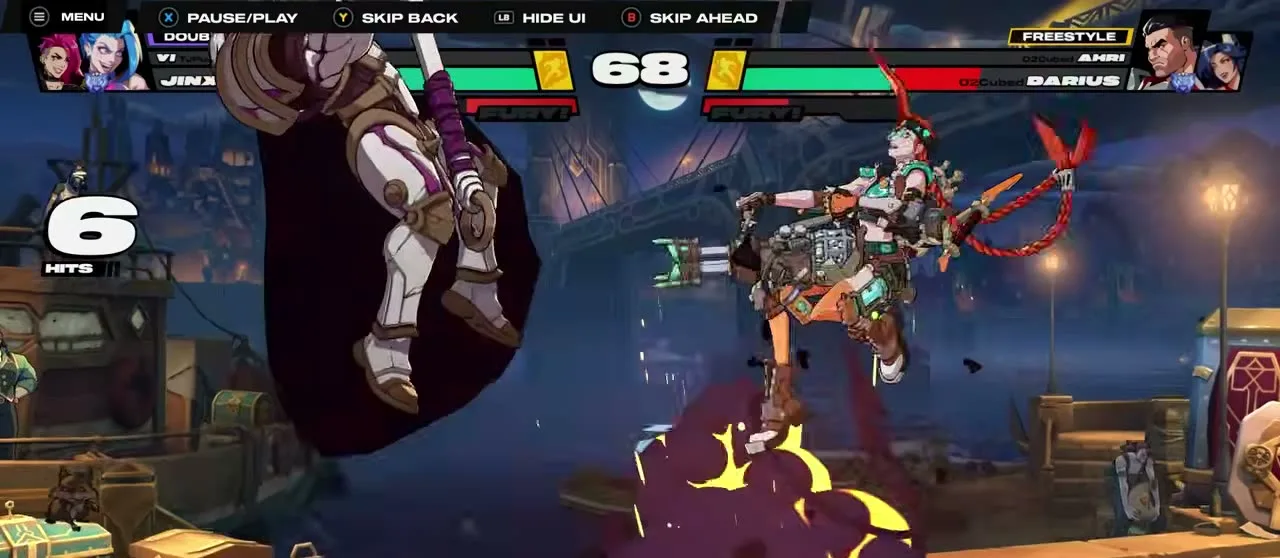
“People don’t see that… a lot of people aren’t reacting to this anymore. So it gives you tons of pressure to be able to move up.”
The charge is not the payoff. The payoff is that it puts you at point-blank range with the opponent still holding block, which is where the guessing game you actually want starts. In the clip he throws a trap, charges the heavy, baits out a move, and grabs. Note the honesty in his own commentary: he says that if he had gone for a light and a tick throw instead, Darius’s super armour would have beaten it. He picked the grab because he had read the armour, not because the grab is automatic.
Your lights beat their grabs
Short, blunt, and worth memorising:
“I dashed forward and I baited like as if I was going to grab. Instead, I do the light and the light beats the grab. Your hits beat grabs. It’s faster.”
Once you have run the charged-heavy walk-up two or three times and taken a grab with it, your opponent starts pre-emptively grabbing to escape. That is when the dash-in looks like another grab attempt and comes out as a light instead. It beats their grab clean, and in this clip it takes their Break.
This is why the sequence matters more than any individual option. The charged heavy sets up the grab; the grab sets up the light.
Back heavy, not down heavy, is your mid-screen anti-air
This is the moment he stops the replay, takes it over, and drills the correction on camera. He calls it a learning lesson, and it is the most concrete fix in the video.
The problem with down heavy
He gets the read right, presses Jinx’s down heavy as an anti-air, and it hits — badly. “It hits but it hits at such a weird angle where it doesn’t auto correct with them.” A correct read that produces a bad hit is arguably worse than a whiff, because you paid for the information and got nothing for it.
The fix, in order
- Tag first.
- Back heavy as the anti-air — “this back H covers everything.”
- Missile.
- Combo into a ground bounce, relaunch, minigun.
- Level three.
His summary is worth pinning to your monitor: “if you’re mid-screen and they’re close like this, don’t react with down heavy, react with back heavy.” Same read, same timing, one different direction, and the conversion goes from an awkward stray hit to a full level-three cash-out.
Jinx’s anti-air is a range check, not a button
He is candid that Jinx does not have good buttons — but adds an important qualifier:
“Jinx doesn’t have good buttons, but in this scenario, when they’re at this range, this anti-air is actually really nice, whether they’re on the ground or in the air.”
And the condition that makes it worth the most: “when Jinx is in the corner, like you would net the most value.” That is the opposite of how most people think about being cornered. With her back to the wall the horizontal escape options are gone, so the button that covers both ground and air at one specific distance suddenly does the work of three buttons.
Treat it as a spacing tool with a narrow band, not a panic button. Outside that band it is exactly the mediocre button he says it is. There is more on how her buttons fit together in the full Jinx guide.
Play the assist timers, not just the characters
Several rounds in this set are decided before either character presses a button, by whose assist is available. He narrates the check out loud: look at the top of the screen, see whose assists are on cooldown, then decide whether to walk in or wait.
Jinx’s missile beats the assist war
“Jinx’s missile is going to beat whatever assist they Darius can do.” When both players get their assists back at the same time, that is not a neutral situation — it is a matchup he wins. So he backs off and plays the assist rather than dashing in.
Always do something before you tag
Small habit, big payoff: “Always do something before you call your tag.” In the clip he throws a trap first, then tags. The trap is not the point — the point is that a raw tag is a free punish, and covering it with anything forces them to respect the screen. He misses his follow-up and still gets the hit, purely because the trap made Darius commit to a parry.
If you want the underlying mechanics for this, the tag system guide covers how assists, tags and cooldowns interact.
The trap setup that deletes their assist option
The best sequence in the set comes after a super, and the super is not the important part.
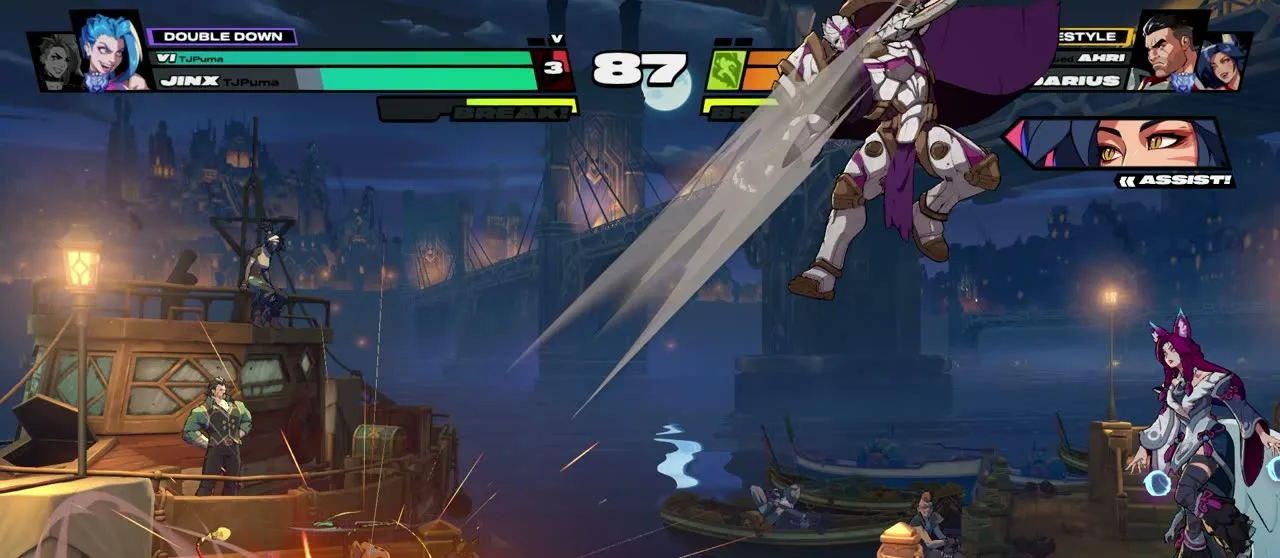
“This super gives you leeway to do everything.” While they are recovering he lays a front trap, lays the ground trap, ignites, and then fires a missile. Now the screen has two live traps and a projectile on it, and the punchline is this:
“You cannot call an assist. That’s the point. People try to call an assist at this level, Diamond, Masters… they call an assist to save themselves. But no. You do not want to do that into Jinx.”
The assist is most players’ universal escape button. A full Jinx board takes it away, and taking away someone’s escape button is worth more than the chip damage the setup does. Note also that he calls the timing on the ground trap deliberately — it travels with the beam and flies at them after the beam ends. For more on when to ignite and when to hold, see the three simple Jinx mechanics breakdown.
Delay the S2 after your heavy or the super goes the wrong way
A genuine quirk, demonstrated twice on camera. Cancel straight from heavy into S2 while they are airborne and the super crosses up — it fires away from the opponent. He replicates it deliberately in takeover so you can see it is not a one-off.
The fix is a small manual delay: “delay the S2 after the heavy, and then you’ll get that.” Wait a beat for them to settle, then cancel. You get the corner carry instead of a super pointed at the wall.
He is clear that he thinks this is a bug rather than intended design, and says Riot should fix it. Worth knowing either way — if it gets patched you lose nothing by having delayed, and until then the delay is the difference between a converted round and a wasted meter.
The round-start staredown
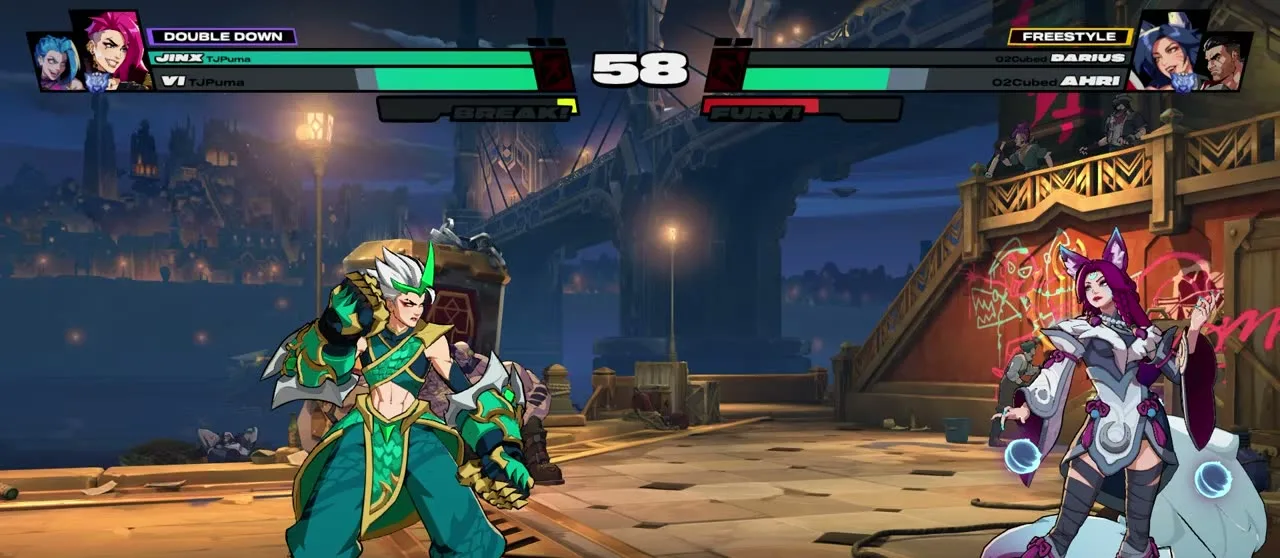
Starting a round with the opponent already in the corner is its own micro-situation, and he breaks the population down into three groups: most players wait, some jump, and some immediately press a button or throw a projectile.
He guesses dash-and-press, and is right. That is a guess — he says so — but it is an informed one, and the useful part is the framework. You are not reading an individual, you are reading which of three buckets this player falls into, and you have already watched them for two rounds.
He also uses round start proactively elsewhere in the set: after noticing he keeps getting stuffed on the opening exchange, he switches to back S2, calls the Vi assist, and fires a Jinx rocket on the way down — covering air and ground at once. His note on that one: “very important, steal that.”
The mistakes he left in, and why they matter more than the tech
He drops a confirm and dies. He goes for a jump medium he knows does not connect. He panics on a punish he had. He accidentally calls a super assist when he wanted a trap. None of it is edited out.
“I know damn well this jump medium doesn’t connect here. Why am I going for that? And that’s just because of the rust… don’t go for fanciness, especially when you’re rusty.”
If you have read much of this blog you have now seen the same finding land from four completely independent directions. The Vi mechanics post measured the simple bread-and-butter doing more damage than the fancy route. The electrics drills put real numbers on it — 344 versus 488 in the wrong direction. A Grandmaster student in the Yasuo and Ekko coaching session dropped a beautiful corner route and lost a round he had already won. And here it happens to the coach, on camera, and he leaves it in.
Four different players, four different ranks, same conclusion. That is about as close to settled as this game gets.
An honest note on where Vi and Jinx sit
He does not oversell his own mains. Talking through a tag that loses to a light he should have won: “this is all because of those nerfs that didn’t allow for Vi to travel as far.” And plainly: “this is why Vi and Jinx are like just not the strongest right now. They’re very mid.”
Later, after losing an exchange he was actually plus in, he catches himself mid-complaint — “I’m not saying buff Vi cuz she was strong for so long, but…” — which is a more useful attitude than either half of the usual discourse.
Two things follow from that. First, this is a snapshot of one patch in July 2026; balance moves, and a video from a different month may reasonably describe her differently. Second, the tech above is not compensating for a weak character — it is what playing a mid-tier team well actually looks like. He still wins the set.
What to take into your next session
- Rebind your anti-air. Mid-screen, close range, airborne opponent — back heavy, not down heavy. Ten reps in training mode is enough to overwrite the habit.
- Add the delay. Standing light, pause, crouching medium. Run it against a bot set to block and watch for the INTERRUPT marker.
- Charge one heavy per round. Not as a combo tool — as an excuse to walk forward. See what they do when you arrive.
- Say the assist timers out loud. Literally narrate “mine’s up, theirs is down” for one session until you stop needing to.
- Do something before every tag. Trap, projectile, anything. Never raw tag.
- Delay heavy into S2. Test it in training mode both ways so you have seen the crossup happen.
If you want a structured place to run these, the training mode settings guide covers the exact toggles — reversals, the data display, block settings — that turn a vague “practise this” into a pass-or-fail drill.
The short version
- Do not fully commit — the hardest punishes in the set all come from committed movement.
- Delayed standing light into crouching medium beats block timings, because 2XKO’s block windows are not lenient.
- Charge the heavy instead of the expected minigun route; use the time to walk in, not to combo.
- Lights beat grabs, so bait the grab-look and press light.
- Mid-screen anti-air is back heavy, not down heavy — down heavy does not auto-correct.
- Jinx’s anti-air is strong only in a narrow range band, and best with her cornered.
- Check assist cooldowns before deciding to approach; Jinx’s missile wins the assist trade.
- Never raw tag — cover it with a trap or projectile first.
- Two traps plus a missile removes their assist as an escape option entirely.
- Delay the S2 after a heavy or the super fires the wrong way.
- Getting fancy while rusty loses rounds you had already won.
Keep going
Full credit to TJPuma for publishing a replay where he loses rounds and says why. He also credits his friend Absolute — an Ahri specialist — for teaching him the corner projectile setup that shows up in this set, which is a reminder that most of the tech at this level travels by word of mouth.
If you play this team, the Vi guide and Jinx guide cover the fundamentals these tricks are built on, and seven Vi pressure tools goes deeper on opening people up. Not sure what you should be working on at your rank? What to practise at every rank lays it out from Aspirant to Challenger.
Come argue about Vi’s tier placement in the 2XKO Jungle Discord, or if you want your own replays picked apart like this, book a coaching session and bring the games you lost.